Track your real estate brokerage financial model monthly — not just at tax time. Learn the snapshot metrics every broker and team leader must know.
If you’re only looking at your profit and loss statement once or twice a year, you’re flying blind. And the worst part? You’re usually looking at it at exactly the wrong time — right in the middle of slow season, when emotions are high and your income numbers look their most brutal.
That’s when agents switch brokerages. That’s when team leaders start slashing commission splits. That’s when broker-owners make reactive decisions that take months — sometimes years — to recover from. I’ve seen it happen over and over again, and it almost always comes back to the same root problem: they don’t have a consistent real estate brokerage financial model they’re tracking throughout the year.
The fix is simpler than you think.
VIDEO: Real Estate Brokerage Financial Model Snapshot
Why the Annual P&L Review Sets You Up to Fail
Here’s what typically happens. Tax season rolls around, you sit down with your accountant or your bookkeeper, and you finally dig into the numbers. And guess what? It’s February. You just came out of your slowest quarter. Your expenses look massive relative to what came in, and emotionally, you’re already beat up from a slow market.
That’s not the right moment to make strategic decisions about your business model.
The good news? When most team leaders and broker-owners actually take their time and work through the full year’s P&L — including the harvest season — things don’t look nearly as bad as they felt. The numbers come into focus. The panic starts to lift. And suddenly, instead of thinking I need to blow everything up, you’re thinking I know exactly what I need to do more of.
Nine times out of ten, the answer is the same: sell more real estate, generate more leads, or recruit more agents. That’s it. You’re not that far off. You don’t need to torch your model. You need to execute.
But you only get that clarity if you’re watching the numbers regularly — not once a year when the pressure is at its peak.
The Monthly Snapshot: Your Real Estate Brokerage Financial Model in One Sheet
The solution is what I call a monthly snapshot. This is not complicated. We’re talking about a simple Google Sheet or Excel worksheet that gets updated on a regular basis — ideally populated by your admin so it doesn’t eat your time — and reviewed at least monthly with your leadership team.
The idea is that you never lose sight of your core financial metrics. You always know your numbers. And over time, you start to develop a feel for the natural seasonality of your business so that slow months don’t catch you off guard.
Watch the full video here to see exactly how this snapshot is laid out: [INSERT VIDEO LINK]
Here’s what your monthly snapshot should include:
For Real Estate Teams:
- Units closed — How many transactions did your team do this month?
- Volume — Total sales volume across those transactions
- Agent count — How many agents are currently on your roster?
- Gross Commission Income (GCI) — Your top-line revenue number
- Listing side income — Broken out separately from buyer side
- Buyer side income — Know where your deals are coming from
- Referral income — Track what’s coming in from referral relationships
- Cost of sales — This is what you’re paying agents per transaction. It’s one of your biggest line items and one you need to watch as a percentage of GCI
- Gross profit — GCI minus cost of sales
- Expenses — Everything else it costs to run the operation
- Net income — Your bottom line
- Operator income — Company dollars in, broken out by personal production vs. team production
As an example, a healthy snapshot might show cost of sales running around 52–53% of GCI, expenses around 16–17%, and net income in the 30% range. Your numbers will vary based on your model and your market, but the point is you need to know what your targets are and whether you’re hitting them.
For Brokerages:
The metrics are largely the same. You’re still tracking GCI, agent count, cost of sales, expenses, and net income — just at the brokerage level. The goal is identical: get your entire leadership team looking at the same numbers regularly so you can spot trends, plan ahead, and make decisions from a place of clarity rather than fear.
-
Quick View
Broker Leadership (Icenhower Institute)
$349ICT Online CourseBroker Leadership
Add to CartLead your brokerage with confidence, clarity, and proven systems.
Training on leadership strategies for brokers and owners
How to recruit, retain, and develop top-producing agents
Systems to create accountability and drive team performance
Financial models to increase profitability at the brokerage level
Culture-building techniques that inspire and engage agents
Downloadable tools, dashboards, and recruiting resources
Develop Leadership Skills
Learn how to set vision, create culture, and guide your brokerage to long-term growth.

Build a Productive Environment
Implement systems that hold agents accountable and drive consistent results.

Recruit & Retain Top Talent
Attract high-performing agents and keep them engaged with proven leadership strategies.
Designed for all learning types
Video Training
In-depth video training walking you through each module of the course, explaining the strategies, tips, and best practices for using Canva for real estate agents.
Written Workbook
Detailed and downloadable written workbook that provides you with a bullet point outline, summarized text, action steps, key takeaways, as well as space for taking notes.
Instructor Materials
Teach this course at your organization with the help of our downloadable presentation notes, presentation files, and Instructor's Manual.
Course curriculum
Enrollment includes access to the following course materials for 6 months
Get Started Here : Introduction- Join the Real Estate Agent Round Table Facebook Group
Welcome to Broker Leadership!
- Module 2 Workbook: Understanding Job Roles
- Video: Job Roles for Admin Staff
- The Solution Triangle
Video: Viral Goals are SMART
Workbook: Module 2 – Viral Goals are SMART
SMART Goals Graphic
Module 2 Action Steps
Video: Viral Goals Spread to the Team
Workbook: Module 3 – Viral Goals Spread to the Team
Small Team Organizational Structure (fillable)
Midsize Team Organizational Structure – Traditional (fillable)
Midsize Team Organizational Structure – Hybrid (fillable)
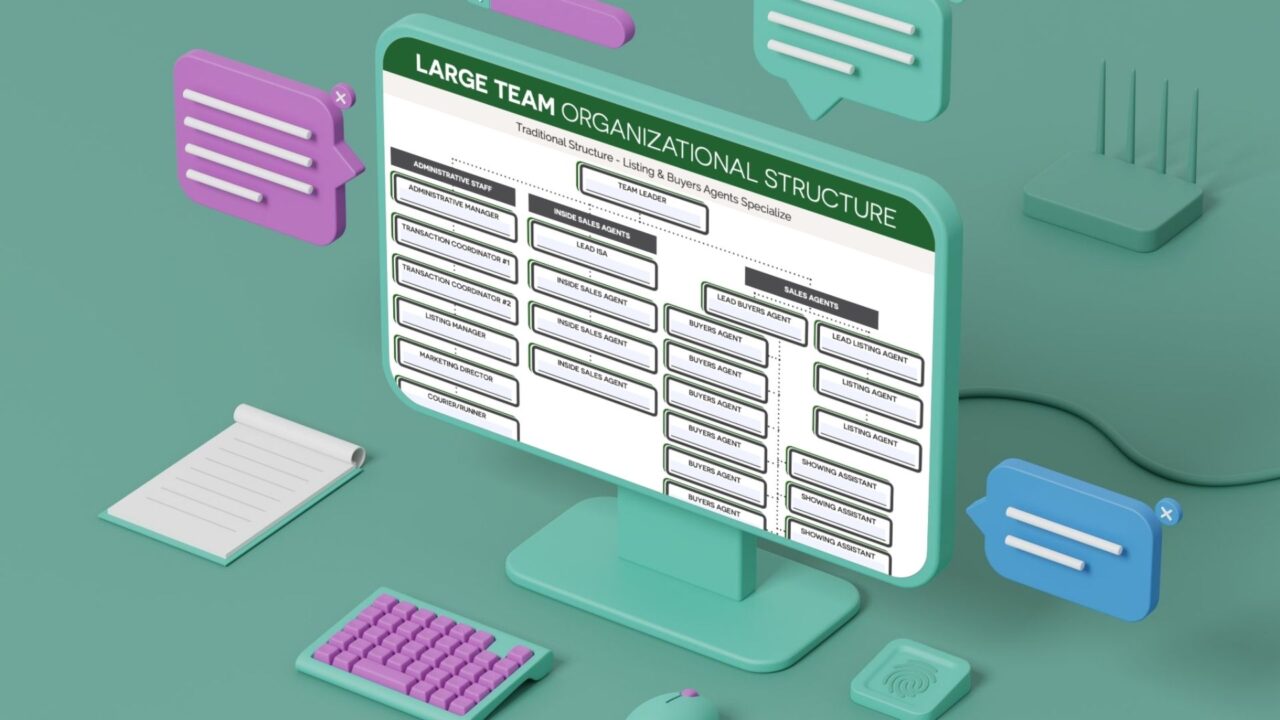
Large Team Organizational Structure – Traditional (fillable)
Large Team Organizational Structure – Hybrid (fillable)
Module 3 Action Steps
Video: Agent Onboarding Calendar
Workbook: Module 4 – Agent Onboarding Calendar
Team Onboarding Calendar Weeks 1-8
Module 4 Action Steps
Workbook: Module 5 – Recruiting Needs Analysis Appointment
Video: Recruiting Needs Analysis Appointment
Needs Analysis Steps Graphic
Module 5 Action Steps
- Video: Training a Recruiter
- Workbook: Module 6 – Training a Recruiter
Video: First Quarter Checklist
Workbook: Module 7 – First Quarter Checklist
First Quarter Checklist for Teams
Module 7 Action Steps
Video: Office Training Calendar
Workbook: Module 8 – Office Training Calendar
Real Estate Office Brokerage Training Calendar
Module 8 Action Steps
Video: Focus on Activities to Grow
Workbook: Module 9 – Focus on Activities to Grow
Module 9 Action Steps
Video: Cultivate Personal Responsibility
Workbook: Module 10 – Cultivate Personal Responsibility
Workbook: Module 11 – Public Accountability
Video: Public Accountability
Module 11 Action Steps
Video: The Essential Tool for Coaching Productivity
Workbook: Module 12 – The Essential Tool for Coaching Agent Productivity
ICC Business Tracker
Module 12 Action Steps
Video: How to Motivate Agents
Workbook: Module 13 – How to Motivate Agents
Module 13 Action Steps
Video: Create a ‘Production-Centric’ Environment
Workbook: Module 14 – Create a Production-Centric Environment
Realtor Group Call Session – The Complete Guide
Module 14 Action Steps
Video: Tracking Activities
Workbook: Module 15 – Tracking Activities
Leadership Dashboard
Module 15 Action Steps
Video: The Recruiting & Retention Mindset
Workbook: Module 17 – The Recruiting & Retention Mindset
Module 17 Action Steps
Workbook: Module 18 – Create a Growth-Oriented Business
Video: Create a Growth-Oriented Business
Team Onboarding Calendar Weeks 1-8
Module 18 Action Steps
Video: The Broker-Manager Business Plan
Workbook: Module 19 – The Broker-Manager Business Plan
1-3-5 Single Page Business Plan Broker Owner – sample
1-3-5 Single Page Business Plan Broker Owner – fillable
Module 19 Action Steps
Video: The Future of Teams & Brokerages
Workbook: Module 20 – The Future of Teams & Brokerages
Module 20 Action Steps
Video: Start Your Own Licensing School
Workbook: Module 21 – Start Your Own Licensing School
About this course
- $349
- 77 lessons
- 6.5 hours of video content
Certification & Designation Upon Completion
In this ICT online course, you will receive an official designation of "Certified Brokerage Manager" or CBM upon completion, as well as a downloadable (and printable) Certificate of Completion. Add your designation seal, as well as your designation letters, to your email signature to bolster your reputation and show off your expertise to clients and colleagues alike.
Reviews
"I use ICT systems, the Icenhower Institute, and the coaching program to coach and train my team of over 30 agents. I use the ICT dashboard systems to keep my entire team accountable for their activities and set proper expectations."

Jake Rockwell
Over 500 Units Sold Annually
"I have coached with ICT for over five years. ICT has helped me quadruple my luxury business through marketing strategies so that I receive listings and sales through lead generation and multiple pillars of income."

Dennis Adelpour
Luxury Agent - West Los Angeles
"When we started coaching with ICT we worked all the time with some degree of success. Now, seven years later, we have grown to have the #1 market share in our area, we more than tripled our income and production, while also improving our work-life balance to enjoy our personal life with family and friends."

Tammi Humphrey
#1 Market Share & 100 Million in Annual Sales Volume
InstructorBrian Icenhower.
I designed Broker Leadership to help broker owners and team leaders on a growth path that helps their entire organization succeed.
I'm so excited to introduce this course to you. It's a high-powered course, whether you're running a real estate brokerage or real estate team ... any real estate organization or company, really. Typically, you have a leadership team (or you'd like to have one) and you have agents within your organization as well.
You will learn about business planning and goal setting for your own leadership team, and also strategies and tactics for helping your agents with business planning and goal setting.
Onboarding systems, orientation systems for new agents and staff members, and training systems for your team are all a huge part of this Broker Leadership course.
You'll also learn recruiting and growth stratgies. We have systems and tools for you to use to ensure your company grows the way you want it to with the type of agents in place so that you're succeeding on a high level.
Together, we will create a production-centric culture in your office, without all the drama and negative mindsets that so often infiltrate organizations in our industry.
In this course you'll have access to ICC's award-winning coaching and training systems, structures and tools to help you implement them, as well as workbooks and tools for in-person training at your office.
Learn how to scale your organization and diversify your business so you can always increase your income along with addingmore personal time for you and your leadership team.
This is one of our most robust, lengthy courses to date, by far the most detailed and thorough course for real estate leaders that has ever been created.

Start leading like the top brokers do.
Get the tools and strategies to recruit, retain, and lead your agents with confidence — start the course today. Add to CartTalk to a coach
If you've been considering hiring a coach, now's the time. Book a FREE coaching consultation session with your purchase of this course! Book Your Call

See all courses
-
Quick View
Brokerage / Corporate Coaching Program
$1,500 / monthWith the Brokerage / Corporate Real Estate Coaching Program, ICT will help firms set up the most effective and efficient systems for recruiting, agent onboarding, commission & fee structures, agent engagement & retention systems, recruiting, administrative work-flows, transaction management, staff hiring, agent onboarding, productivity training & accountability, financials & budgeting, marketing and much more!

What Happens When You Stop Tracking — and Start Reacting
Here’s what I see when broker-owners and team leaders don’t have a real estate brokerage financial model they’re consistently monitoring:
They panic. They start cutting. And the problem with cutting when you’re emotional is that you don’t distinguish between fat and muscle. Trimming unnecessary expenses? That’s smart. Slashing your marketing budget, dropping agents, or blowing up your commission structure because it feels like too much? That’s cutting muscle. And that takes you backwards — fast.
Even worse, some operators start jumping ship. They switch models, move to different companies, try to restructure everything from the ground up — all because they hit a rough patch in January and didn’t have the context to know that January is always rough.
Once you’ve made those moves, they’re hard to undo. You’ve charted a new path, and the time and energy it takes to stabilize again is significant.
The monthly snapshot keeps you grounded. It gives you the context you need to see that one slow month doesn’t define your business. It reminds you that expenses always feel heavy in winter — and that’s exactly why you need to be capitalizing your operating account during your strong spring and summer seasons.
Build the Business Owner Mindset, Not the Emotional Salesperson Mindset
Leaders who don’t know their numbers don’t act like business owners. They act like salespeople having a bad month. They run toward whatever feels safer in the moment, without any real data to back up the move. And they end up on a hamster wheel — always chasing the greener grass, never quite figuring out where the gas pedal is.
Knowing your numbers — consistently, month in and month out — is what separates operators who grow from operators who spin. It’s what gives you the ability to say, I know exactly where I need to push right now, instead of reacting to whatever the market is throwing at you this week.
Start building your monthly snapshot today. It doesn’t need to be fancy. It just needs to be consistent.
Watch the full breakdown at the top of this blog.
Ready to Take Your Business to the Next Level?
At Icenhower Coaching & Training, we work with real estate agents, team leaders, and broker-owners who are serious about building sustainable, profitable businesses. If you’re ready to stop guessing and start growing, subscribe to our YouTube channel, follow us on social, or book a free coaching call, below.
Video Transcript
Prefer to read along? Here’s the full transcript from this training video.
Oftentimes with a profit and loss statement, we do that once — maybe if we’re lucky, twice a year. It’s not a fun exercise for people who haven’t done it before. So what ends up happening is we sit down, we analyze it, and we see where we’re in alignment and where we’re not.
The unfortunate part about tax time is it typically comes after a very slow season. But it’s actually an important time to do it, because then we can start to see how we did for the entire year — including the harvest season — since we have a very seasonally adjusted business. Making harsh decisions in the winter is very damaging.
And then typically after we take a look at the P&L, things don’t look so bad. Because if people start impulsively and emotionally cutting costs, they may cut some fat — which is fine. But if they start cutting muscle, we’re in trouble. We’re taking big steps backwards. Or if we start moving to different companies and aligning with different models out of emotion, we’ve made a choice that’s very challenging to undo. It takes a lot of time, and you’ve charted a new path. Those are steps backwards.
I know it’s weird to talk about emotions and feelings when you’re talking about profit and loss statements, but believe me, it’s real. All of a sudden you look at the numbers and think, “I’m not that far off.” You get clarity. Here’s exactly what I need to do — and nine times out of ten, it’s: I need to recruit more agents as a broker, sell more real estate, or lead generate more. I’m actually not that bad. There’s a way to grow out of this, even if expenses are a little bit ahead of income, without cutting too much muscle.
There’s a way to keep that mindset going throughout the year. Because what we start to learn is that a lot of team leaders and brokerage owners see what they’re paying agents and assume the agents aren’t doing anything. So they start cutting agents. They start changing commission structures — when the answer might actually be to add more agents. Since costs are fixed, economies of scale kicks in. So we want to keep our cost of sales number always in mind — how much we’re paying agents per transaction. That’s a big chunk of our expenses.
What we do is create a monthly snapshot. It’s often part of a team dashboard or a brokerage dashboard. Every month, we’re sitting down and looking at these numbers — usually auto-populated by the administrative person — so it shouldn’t take a lot of time. At least at one of our monthly leadership meetings, we’re reviewing these numbers together.
Here’s what the team snapshot looks like. It’s simple — a Google Sheet or Excel worksheet. We’re tracking:
- Units closed
- Volume
- Agent count
- Gross Commission Income (GCI)
- Listing side income
- Buyer side income
- Referral income
- Cost of sales (as a percentage of total GCI)
- Gross profit
- Expenses (as a percentage)
- Net income
- Operator income — total company dollars, broken out by personal production and team production
We have to know what these metrics should be, which varies based on our budget and where we’re at. These are lag measures — results-based indicators, not activity-based indicators. We’re looking in the rearview mirror. They’re not immediately actionable, but they remind us on a regular basis where the business is trending.
We’ll start to notice how different the numbers look in winter versus spring and summer. That creates a mental awareness where we’re always tied to our numbers. The P&L never just goes away and then comes back as a surprise. We always know our numbers, and we start to get better at preparing for the winter months. After one full year of tracking, we start thinking: here come those months where production goes down and expenses feel heavy. What are we doing to capitalize our operating account so we have money in the bank heading into winter? Very important.
I’ve done something similar with the brokerage — essentially the same dashboard, same metrics — so that the entire leadership team sees it, we’re all talking about it, and we start to see trends from year to year. We always know our percentages and whether we’re in alignment with our budget schedule.
This keeps our mindset where it should be — like a business owner, not an emotional salesperson. When I go over profit and loss statements with people who haven’t been using a snapshot, I’m dealing with a lot of anxiety, fear, and impulsive decisions to switch models. All the goals go away. All the dreams go away. And it’s just: I’m going to run to safety.
That’s what happens when someone doesn’t know their numbers. Leaders have to know their numbers. Coaches have to know their numbers. Otherwise, you’re going to see them jump around constantly — on a hamster wheel, grass is always greener — never really knowing where their gas pedal is or how to actually increase profitability.
Hope that helps.