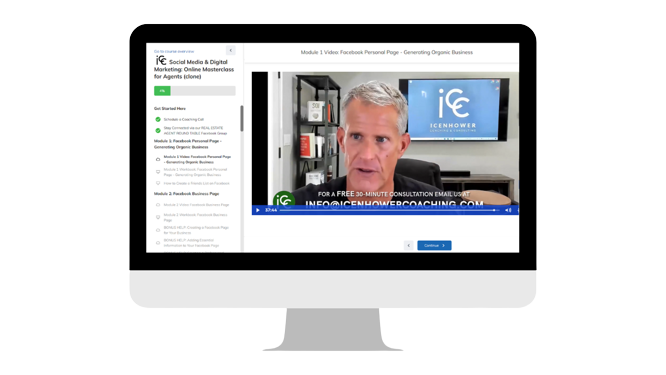
Your profit & loss statement for real estate teams was built by a tax preparer, not a CFO. Here's how to rebuild it and find your real numbers.
I know this is not sexy talk. Nobody got into real estate because they wanted to read financial statements. But I cannot tell you how many different ways this one document affects the mindset of a team, and almost always in a bad direction, because most team leaders are reading a profit & loss statement for real estate teams that was never built to be read that way.
Here is what happens. It is January or February. Production is slow. Tax time is coming. Your accountant hands you a P&L, you look at the bottom of it, and you feel sick. Your expenses look enormous. Your net income looks tiny. And you start thinking things like “I would be better off as a solo agent.”
That thought has ended more real estate teams than any market ever has.
VIDEO: Sample Profit & Loss Statement for Real Estate Teams – Free PDF Download
Your accountant is a tax preparer, not a CFO
Most real estate team leaders use an accountant as a tax preparer. That is it. And that is a horrible thing for your business, because your accountant needs to be a CFO for you too.
The top corporations have real CFOs, people whose job is to look at the business and tell them what is actually happening. You have somebody whose job is to reduce your tax bill. Two different jobs, two different documents.
So all of a sudden your P&L looks much, much different than it should look to a business. Very few real estate teams have a CFO. They just have a tax preparer. And that is why they see such a negative side of things.
This matters more than it used to. Sales volume has been sitting at historically low levels for a while now. When volume is tight, scarcity mindset creeps in, and we start acting off emotion instead of logic. We are not playing with the right information. We look at a P&L we do not know how to read, we decide it is not working, and we make a change.
You see it everywhere. Team leaders who give up on building any kind of profit margin and go start a team at a revenue share company instead. “I do not make as much off the agents this way, but I am going that direction.” That is a lateral move. They changed their entire business model because they could not analyze a P&L.
We call the winter the moving season for a reason. People declare it is not working, they put the white flag up, and the idea of ever getting out of production goes away. They justify it to themselves based on emotion, not logic.
Let’s prevent that. Let’s make informed decisions instead.
-
Quick View
Agent Financials (Icenhower Institute)
$299ICT Online CourseAgent Financials
Add to CartMaster the numbers that drive your real estate business.
Learn financial models that top agents use to maximize profit
Track expenses, budgets, and ROI with simple systems
Understand profit margins, income streams, and growth benchmarks
Build financial dashboards to monitor performance at a glance
Strategies to scale while protecting profitability
Downloadable spreadsheets, templates, and tracking tools

Gain Financial Clarity
Understand your income, expenses, and profit margins so you can make smarter business decisions.

Implement Proven Models
Use simple financial systems and dashboards to track budgets, ROI, and agent performance.
Protect & Grow Profitability
Apply strategies to scale your business while maintaining healthy margins and long-term stability.
Designed for all learning types
Video Training
In-depth video training walking you through each module of the course, explaining the strategies, tips, and best practices for using Canva for real estate agents.
Written Workbook
Detailed and downloadable written workbook that provides you with a bullet point outline, summarized text, action steps, key takeaways, as well as space for taking notes.
Instructor Materials
Teach this course at your organization with the help of our downloadable presentation notes, presentation files, and Instructor's Manual.
Agent Financials
More about this real estate training course
Course curriculum
Enrollment includes access to the following course materials for 6 months.
Module 1: Managing Agent Financials- VIDEO: Managing Agent Financials
- AUDIO: Managing Agent Financials
- Workbook: Managing Agent Financials
- Agent Financials Banking Accounts
- VIDEO: Mastering the Realtor Budget
- AUDIO: Mastering the Realtor Budget
- Workbook: Mastering the Realtor Budget
- Real Estate Budget Schedule (example)
- Real Estate Budget Schedule (fillable)
- VIDEO: Grasping the Profit & Loss Statement
- AUDIO: Grasping the Profit & Loss Statement
- Workbook: Grasping the Profit & Loss Statement
- Sample Profit & Loss Statement
- VIDEO: Analyzing Business Financials
- AUDIO: Analyzing Business Financials
- Workbook: Analyzing Business Financials

About this course
- $299.00
- 15 lessons
- 1.5 hours of video content
Reviews
"I use ICT systems, the Icenhower Institute, and the coaching program to coach and train my team of over 30 agents. I use the ICT dashboard systems to keep my entire team accountable for their activities and set proper expectations."
Jake Rockwell
Over 500 Units Sold Annually
"I have coached with ICT for over five years. ICT has helped me quadruple my luxury business through marketing strategies so that I receive listings and sales through lead generation and multiple pillars of income."

Dennis Adelpour
Luxury Agent - West Los Angeles
"When we started coaching with ICT we worked all the time with some degree of success. Now, seven years later, we have grown to have the #1 market share in our area, we more than tripled our income and production, while also improving our work-life balance to enjoy our personal life with family and friends."
Tammi Humphrey
#1 Market Share & 100 Million in Annual Sales Volume
InstructorBrian Icenhower.
I created Agent Financials because there is simply no other training out their like this specifically for real estate agents.
Most agents have no idea where they are at financially.
You are not an "average agent", though, and you are tired of living your life (and running your business) by looking through the rear view mirror. It's time to learn how your P&L Statement and budget can be used to start looking through the windshield as you navigate your way through the process of growing your business.
Now is the time to step up your game.
This is a high-level course that has been boiled down to the essentials. I'll explain everything from start to finish, and by the end, you'll feel much more comfortable with your financials, and you can immediately begin to put what you learn into action.
You will learn the necessary changes that you need to make to get on track to grow the real estate business of your dreams.

"My business is growing, but for some reason, I'm broke."
We hear this all the time. When real estate agents don't truly understand their financials, they always feel in the dark about their numbers.
It's time to take control. Empower yourself to understand your financials so you can start making decisions today that will impact your business's future success.
Add to CartTalk to a coach
If you've been considering hiring a coach, now's the time. Book a FREE coaching consultation session with your purchase of this course! Book Your Call

See all courses
-
Quick View
1×1 Solo Agent Weekly Coaching Program
$1,000 / monthThis 1×1 Solo Agent Weekly Real Estate Coaching Program designed to help you increase your production and your commission income with strategies and systems for sustainable business growth.

Start with the budget schedule
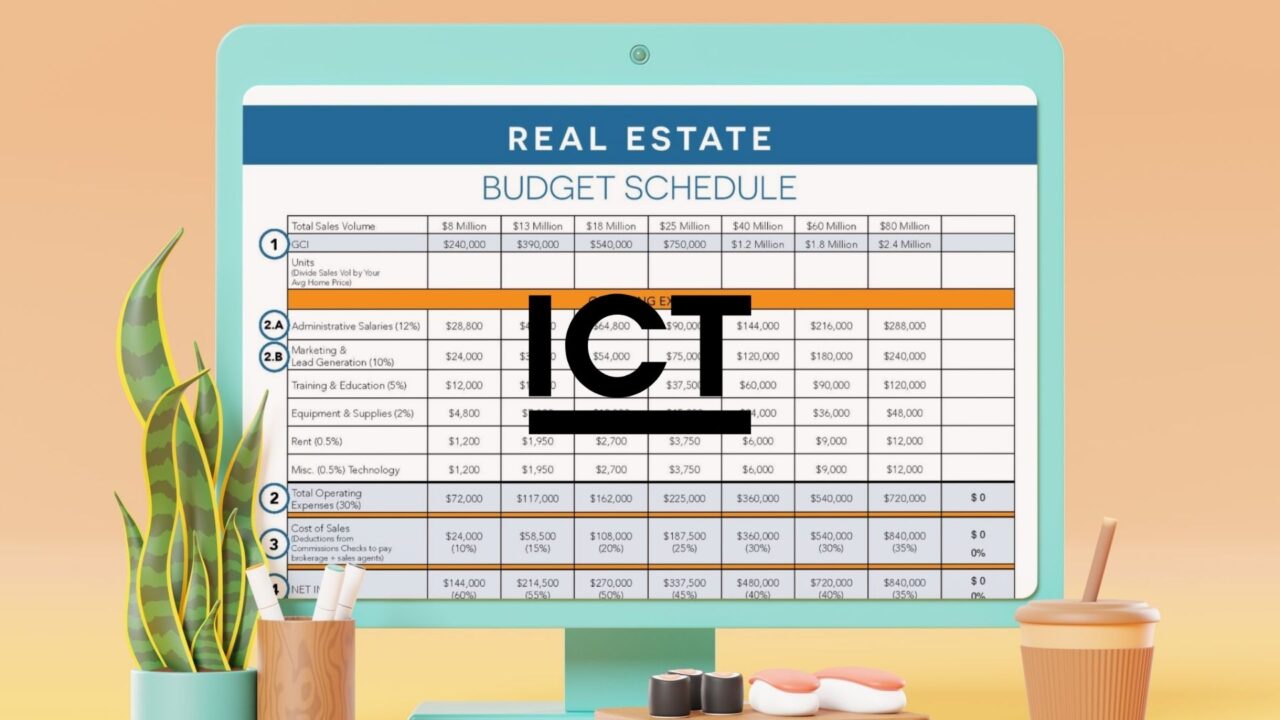
Before you touch your P&L, you need a model to compare it against. That is the Real Estate Budget Schedule, and it is built on four numbers. Learn them, because these are the only ones I look at when I analyze a team.
1. Total gross commission income. This is the team’s GCI. Everything else is a percentage of this number.
2. Operating expenses. Hold these at 30% of GCI. Two pieces make up most of it:
- 2a. Administrative salaries: 12% of GCI
- 2b. Marketing and lead generation: 10% of GCI
3. Cost of sales. This is what you pay your agents. Their agent dollar. On a 50/50 split, half the commission goes to the agent and half stays with the team.
4. Net income. What is left.
Those operating expense percentages hold steady as you grow. What changes is cost of sales and net income, and they move in a direction that scares people who do not understand it.
As your team grows, cost of sales goes up. It has to. A small team with one or two buyer agents might only pay out 10%, because most production still comes from the team leader. As you add agents, more of your production comes from other people, so the percentage climbs and the dollar amount climbs. That is the whole point. The team leader can only sell so much.
And your net income percentage goes down as you grow. That is your profit margin, and like any business, we actually want to push the margin down while the net income dollar amount goes up. More production coming from your agents, less coming from you.
If nobody has explained that to you, a shrinking margin looks like failure. It is not. It is growth working correctly.
-
Quick View
Agent Financials (Icenhower Institute)
$299ICT Online CourseAgent Financials
Add to CartMaster the numbers that drive your real estate business.
Learn financial models that top agents use to maximize profit
Track expenses, budgets, and ROI with simple systems
Understand profit margins, income streams, and growth benchmarks
Build financial dashboards to monitor performance at a glance
Strategies to scale while protecting profitability
Downloadable spreadsheets, templates, and tracking tools
Gain Financial Clarity
Understand your income, expenses, and profit margins so you can make smarter business decisions.
Implement Proven Models
Use simple financial systems and dashboards to track budgets, ROI, and agent performance.
Protect & Grow Profitability
Apply strategies to scale your business while maintaining healthy margins and long-term stability.
Designed for all learning types
Video Training
In-depth video training walking you through each module of the course, explaining the strategies, tips, and best practices for using Canva for real estate agents.
Written Workbook
Detailed and downloadable written workbook that provides you with a bullet point outline, summarized text, action steps, key takeaways, as well as space for taking notes.
Instructor Materials
Teach this course at your organization with the help of our downloadable presentation notes, presentation files, and Instructor's Manual.
Agent Financials
More about this real estate training course
Course curriculum
Enrollment includes access to the following course materials for 6 months.
Module 1: Managing Agent Financials- VIDEO: Managing Agent Financials
- AUDIO: Managing Agent Financials
- Workbook: Managing Agent Financials
- Agent Financials Banking Accounts
- VIDEO: Mastering the Realtor Budget
- AUDIO: Mastering the Realtor Budget
- Workbook: Mastering the Realtor Budget
- Real Estate Budget Schedule (example)
- Real Estate Budget Schedule (fillable)
- VIDEO: Grasping the Profit & Loss Statement
- AUDIO: Grasping the Profit & Loss Statement
- Workbook: Grasping the Profit & Loss Statement
- Sample Profit & Loss Statement
- VIDEO: Analyzing Business Financials
- AUDIO: Analyzing Business Financials
- Workbook: Analyzing Business Financials
About this course
- $299.00
- 15 lessons
- 1.5 hours of video content
Reviews
"I use ICT systems, the Icenhower Institute, and the coaching program to coach and train my team of over 30 agents. I use the ICT dashboard systems to keep my entire team accountable for their activities and set proper expectations."
Jake Rockwell
Over 500 Units Sold Annually
"I have coached with ICT for over five years. ICT has helped me quadruple my luxury business through marketing strategies so that I receive listings and sales through lead generation and multiple pillars of income."
Dennis Adelpour
Luxury Agent - West Los Angeles
"When we started coaching with ICT we worked all the time with some degree of success. Now, seven years later, we have grown to have the #1 market share in our area, we more than tripled our income and production, while also improving our work-life balance to enjoy our personal life with family and friends."
Tammi Humphrey
#1 Market Share & 100 Million in Annual Sales Volume
InstructorBrian Icenhower.
I created Agent Financials because there is simply no other training out their like this specifically for real estate agents.
Most agents have no idea where they are at financially.
You are not an "average agent", though, and you are tired of living your life (and running your business) by looking through the rear view mirror. It's time to learn how your P&L Statement and budget can be used to start looking through the windshield as you navigate your way through the process of growing your business.
Now is the time to step up your game.
This is a high-level course that has been boiled down to the essentials. I'll explain everything from start to finish, and by the end, you'll feel much more comfortable with your financials, and you can immediately begin to put what you learn into action.
You will learn the necessary changes that you need to make to get on track to grow the real estate business of your dreams.
"My business is growing, but for some reason, I'm broke."
We hear this all the time. When real estate agents don't truly understand their financials, they always feel in the dark about their numbers.
It's time to take control. Empower yourself to understand your financials so you can start making decisions today that will impact your business's future success.
Add to CartTalk to a coach
If you've been considering hiring a coach, now's the time. Book a FREE coaching consultation session with your purchase of this course! Book Your Call
See all courses
-
Quick View
Team Coaching Program
$1,250 / monthThe Team Real Estate Coaching Program is for smaller teams looking for internal structure, leverage and leadership.

How to actually analyze your profit & loss statement
Now open the P&L. Here is where people freak out. Go in this order.
Step one: find your real GCI.
Your accountant is going to show a commission income number that is really just what you earned, because you never told them what you paid your agents. That is not your team’s GCI. That is your team dollar.
So pull your own records, or your brokerage’s records, and add up the agent dollar. In the sample I walk through in the video, the accountant showed $354,633 in commission income. The team had paid $99,800 out to agents. Add them together and the team’s true GCI is $454,433.
That is your 100% number. Every percentage comes off it. Skip this step and every ratio you calculate afterward is wrong.
Step two: find your real operating expenses.
Your accountant will show a total expense number that is extraordinarily high. It is a big scary number sitting at the bottom of the page, and it is one of the main reasons team leaders say their business is not making money.
Two things have to come out of it.
First, your own salary. If you are paying yourself a salary or a draw out of your entity, that is not a real business expense. That money goes right back into your pocket. Back it out. In the sample, that takes total expenses from roughly $250,000 down to $197,000.
Second, the personal items. Your accountant put them there to reduce your taxes, and that is fine, that is their job. But we are analyzing a business now. The divorce attorney you deducted as a business attorney. Your health insurance, which you would need anyway. Your car payment. Your cell phone. The two computers and the printer you bought for the house and put under the business. We have to be real here. In the sample, that added up to $31,000.
Back it out and true operating expenses land at $163,000. Suddenly it does not look so bad.
Step three: check it against the model.
$163,000 against a true GCI of $454,433 is 36%. The target is 30%. So this team is running a little high, but nowhere near the disaster the original P&L suggested.
Then check your two biggies. Administrative salaries in the sample were at 15% against a 12% target, a little high, and remember to include payroll taxes there. Marketing and lead generation came in at 9.1%, right where it should be. You want that under 10%, but not too far under, or you are not going to grow. Marketing is what brings in revenue and agents.
Step four: recalculate net income.
Your net income on the accountant’s P&L is historically low, because making it low is your CPA’s job. In the sample it showed about $103,000. Once you use real GCI and real operating expenses, net income comes out to $150,257, which is 33% of GCI.
Same business. Same year. Completely different story.
What the analysis almost always tells you
Here is the part nobody wants to hear.
When a team is running 36% operating expenses against a 30% target, you have two options. Cut expenses, or grow into them. And seven or eight times out of ten, the answer is grow into them.
The expenses in that sample are not wild. The team is just not big enough yet. Their agents only brought in $99,800 of production, and most people who start a team are up in the hundreds of thousands. Bring on five more agents, GCI goes up, and that same $163,000 becomes a much smaller percentage of it. The number fixes itself.
So now the real estate coach is telling the team leader to recruit, and you have actually proved to them why. They do not want to hear it, because recruiting is the hardest thing in this business. Just like lead generation is the hardest thing for an agent. People will do anything they can to justify not doing it.
In the meantime, play red light green light with your expenses. At 36%, you are at a red light. You do not spend another nickel until production comes up and that percentage comes down. Once you are closer to 30%, the light turns green and you can hire again.
The small team death zone
Most people who quit never make it past $100 million in sales volume. They quit way before that, stuck in what I call the small team death zone.
It is a real death zone. You are selling just as much as you always have, and now you are also handling recruiting, retention, training, and every bit of drama that comes with agents. Double the work for a little bit more money. So people burn out, and they start telling themselves it is not worth it.
Then they get reluctant about recruiting and they start using words like selectivity. “I only want agents who will do this.” Anything to justify not growing through the problem. “I do not want a big team.” Fine. Just understand that you will always want one a teeny bit bigger, because each step up gets you more income and less work at the same time. Pretty soon it is a big team anyway.
What we do not want is you stuck in the middle, convinced you cannot go forward. You can. Your mind will start turning into crazy town and telling you this is not working. Generally speaking, what we see is that it is working, and you need to keep growing.
The gas pedal is usually the problem. It is not usually expenses. It just feels that way, especially in the off season.
Do this before your next slow month
Get your P&L out. Add your agent dollar back in. Back out your salary and your personal items. Run the four percentages. Then decide whether you have an expense problem or a production problem, because they have completely different solutions and only one of them is common.
Most of all, stop making a business decision on a document that was built for the IRS.
If you want the sample P&L I walk through in the video, we made it a free download. And if you want the whole thing broken down line by line, that is what the Agent Financials course is for. Either way, start knowing the back end of your business. Do not just be all sales and marketing. We know the operations side too.
Video Transcript
Prefer to read along? Here’s the full transcript from this training video.
So, talking about a real estate team’s profit and loss statement. I know this is not sexy talk for a lot of people out there, but I cannot tell you how much, how many different ways this impacts the mindset of a team, in a positive way.
Because without it, you go into emotion. You go into very negative places, and you typically will see this with seasonality. You will see this really bad in the winter when there is not a lot of production. It also happens to coordinate with tax time. As you move into the month of April, you start to see it, because most people use an accountant just as a tax preparer, which to me is a horrible thing. Your accountant needs to be a CFO for you too. And unfortunately, they do not have those. They do not have the really good accountants the top corporations do. They just try to reduce your taxes.
So all of a sudden P&Ls look much, much different than they should look to a business. So it is very important to understand that difference, because very few real estate teams have a CFO. They just have a tax preparer, so they see a very negative side of things. And we have seen that especially when sales volume drops.
And when that happens, we get into scarcity mindsets. We start to act off of emotion a lot more than we do logic, and we are not playing with the right information. If we do not know how to analyze the profit and loss that our accountant provides us, we just start to go into scarcity. This is not working. I need to make changes.
So it is no wonder that we have seen so many people gravitate away from doing this themselves. A lot of teams have just given up building a real estate team with any type of profit margin whatsoever and started a team at a new revenue share company. “This is my new team. I do not make as much off the agents this way, but I am going to move in that direction.” And you see it all over the place. People just doing what I call lateral moves. They are changing their entire business model just because they cannot analyze a P&L.
And they operate off of emotion, not logic. I am tired of putting in money. So that is why we call the winter the moving season. So many agents and so many teams move during that period of time and they declare that it is not working. So they make a change, and they give up, and they put the white flag up, and the idea of them ever getting out of production, or at least even having more production from the other agents than themselves, goes away. So they make lateral moves and they justify it to themselves based on emotion, not logic.
So with that being said, I want to jump into this, because we want to prevent that. We want informed decisions. We do not want emotional decisions that are so pervasive in the real estate industry.
Okay, so I am going to show you something very quickly first. Everything that I am talking about is in our Agent Financials course, including the image I am about to show you. So we have a course on this that explains it in much greater detail. I am going to give you a real quick overview right now.
We have a real estate team budget schedule. Each column represents the amount of total sales volume and gross commission income. And the numbers do not matter too much here, believe it or not, if they are all that accurate. So as you move up in production, you move from left to right across this schedule, and I stop it at $100 million. We have a lot of teams we coach that go way past that too, but you start to get the trend here. I just want to explain the concept for you, because most people that give up are before they hit $100 million in sales. Most people that put up the white flag, they are in that small team conundrum where they have to both sell a lot themselves and manage the leadership of the team. And that is double the work for just a little bit more money. That is where most people put up the white flag and quit.
So the first thing I want you to look at is these numbers down the left hand side. The first thing we take a look at is the team’s total gross commission income. Then we go down to number two. We look at the team’s operating expenses. We always hold that at 30%. And the two big pieces of that are 2a and 2b. They are administrative salaries, and they are marketing and lead generation. So we try to hold operating expenses at 30%, and then administrative are 12% of GCI. Everything is taken from GCI. So operating expenses 30% of GCI, administrative salaries 12% of GCI, marketing and lead gen 10% of GCI. And we hold those numbers all the way through. Those do not change a lot.
What does change is number three, the cost of sales. This is, for all intents and purposes, what we pay our agents. It is their agent dollar from a commission split. If a team is on a 50/50, 50% of that commission split goes to the agent. That is the agent dollar. 50% goes to the team. That is the team dollar. So cost of sales is what is paid out to the agents, and you will see this number does change. A very small team, maybe with one or two buyer agents, still most of the production is coming from the lead agent, the team leader. So only 10% is paid out. But as the team grows, you are going to see this number goes up, because you are getting more and more agents and a higher percentage of your production is coming from other agents. So the percentage is going to go up, because the team leader can only sell so much. And the dollar amount is going to go up. And quite frankly this number is probably going to keep going even past this chart, because that is the idea. Get out of production and get a lot of production from your agents. But unfortunately we start to say we are paying all the agents too much, and bad decisions get made there.
Then net income is number four. Again, your net income percentage will always go down as you grow. The percentage will go down. That is your profit margin. Believe it or not, we actually, like any business, try to push the profit margin down while the net income amount goes up. Why? Again, more production is coming from your other agents, less coming from you, and the amount that you sell, you typically keep all that.
Make sense? Very simple. Remember these numbers: 1, 2, 2a and 2b, 3, and 4, because that is primarily what I am going to analyze when I take a look at the profit and loss. I am not going to look at too much outside of that. Again, this sample profit and loss is also in our Agent Financials course with some analysis. Now this gets a little squirrely because there is a lot of my chicken scratch all over it, but again, if you follow the numbers in order, 1, 2, 2a, 2b, 3, and 4, it should make sense to you.
So moving over to the P&L. Here we go. Hold your breath. This is where people freak.
Now you can take a look here, starting at number one. Remember, start at number one. The first thing we are going to do is calculate the team’s GCI. Very easy. Typically what is going to happen is your accountant is going to show a GCI amount which is really just the amount you earned. So we do not know how much you paid your agents, because you typically do not tell that to your accountant. That is just your commission. We can take out, if you have a property management or something, how much revenue you had. This is just revenue. It is money taken in. It is team dollar, agent dollar.
And we have to start there, because we take everything from GCI. Remember, this is the team’s GCI. So what I need to do also when I am calculating the team’s GCI is see how much we paid our agents. So we have to find out the agent dollar. Remember, it is the team’s total GCI. So please understand this. It is how much the team made, not just what you showed your accountant. So if we paid, in this case, about $99,800 to our agents last year, we are going to add that to how much you made to get a total team GCI of $454,433.
Everybody with me? Now we have got our 100% number. So we are not going to see that number on a P&L. We are not going to get the cost of sales, the cost of what we paid to our agents with each sale, on a P&L. Now some accountants will do that for you, but most do not. So we are going to have to find that just by our own records. Maybe your brokerage office keeps those, and we can add them up. Whatever it is, we always have to know what we are paying our agents.
And so we have got a 100% GCI number of $454,433. Then we are going to go down to number two and look at our operating expenses, and typically they will have a total expense amount that is extraordinarily high. A big old number that scares the heck out of clients. It is one of the reasons they say my business is not making money, because they see that number down at the bottom. Just by looking at this, you could see I made $354,000 for my GCI that the accountant listed, and I look and I made $250,000 in expenses. I only made $100,000. I would be better off as a solo agent making $300,000 myself. That is where teams go. But unfortunately they are not looking at the real picture. That is why we have to do this analysis.
So we have to calculate their true operating expenses. So we take the number that the accountant gave us, and then usually we are paying ourselves a salary too, so we have to deduct that from it. That is not a real expense. Come on. That goes right back in your pocket. So if you are getting paid a salary or a draw or something like that for your corporation, or however you want to take it in for whatever entity you have, we have to put that back into this equation. So I just deduct it from the operating expense, because it is not a true expense. Make sense?
Then we jump down and that gives us a new number of only $197,000 in expenses. Then I am going to go through and take a look at 2c up here. That was not on the first schedule. And I am going to look for all the personal crap they are putting in here. And I get it, your accountant wants to not make you have to pay a lot of taxes, and that is cool, but we are analyzing your business now. So if you went through a divorce and you said it was your business attorney so you could deduct it, we are not going to do that. Your business is not really losing that money. Same with health insurance. You are probably going to need that anyway. Your car payment, you are probably going to use that anyway. Cell phones, we are going to use that anyway. You bought two new computers and printers for your house and your kids, but you put them under your business. We have to be real here. We are analyzing a business.
So we are going to back out the personal expenses, and here I added them all up, and in this case it equaled $31,000. And now we have got a true operating expense amount of $163,000. Doesn’t look so bad anymore. Still a little bit high, because they are at 36% of GCI, and we remember on my budget schedule they should be at 30%. So they are a little high. Maybe we just need to recruit a little bit more production in rather than just cut the expenses, because typically the percentage will go down if we get a little bit more production. So five agents and their production might bring that down to 30%. So you can grow through it with production.
Now I also like to play red light green light with expenses. I do not want to expend anything more until we have got that down closer to 30%. So I do not want to increase my operating expenses either. So I am going to put up a red light right now, because we are at 36%. We are not going to spend another nickel until we can increase our production a little bit. And typically with real estate teams, that is going to come from adding more agents to the team. More agents come in, that will increase the GCI, and this $163,000 amount will be a much smaller percentage of it, and that percentage will come down to 30%.
That makes sense. And so now the real estate coach is telling the real estate team leader, you have got to recruit. And you have actually just proved to them why, because they do not want to hear that. They want to change, because recruiting is the hardest thing in this business. Just like to an agent, lead generation is the most important thing for them, and it is the hardest. They will do anything they can to justify not doing this. But they are on the right track here.
Does this make sense? I also want to make sure of the two biggies that I said. 2a, their admin salaries, is a little bit high right here. Should be 12% of GCI as I showed you on the budget schedule. They are at 15%. And typically we have to add payroll taxes with how much we are paying them in salary and things like that. Then I am going to look at their marketing expenses as well too. How much are we doing in advertising and marketing? And that needs to be below 10%, not too far below, or we are not going to grow, because marketing does increase revenue and agents. But they are at 9.1%, so we are pretty good on that one. We are a little high on admin salaries. We can probably grow into that too by bringing on more agents.
Now the net income number is also usually historically low, because that is your CPA’s job. On that, I want to make sure that we take a look here. Here is the net income number of $103,000. I am going to add back in, so I am going to take that number of $354,000, which is your gross commission income, I am going to subtract the operating expenses that I calculated under number two, the real operating expenses, and show them a new net income of $150,257, which is now 33% of GCI.
Does that make sense? What this tells me, just from this particular team, is yeah, they are a little ahead on their admin expenses, which is actually pretty rare for real estate teams to invest a lot in their admin. Generally speaking, if we were a little larger, it would be justified. This would generally, without me knowing what is going on with this team in particular, because I made all these numbers up, tell me we need more agents. We need to recruit through this. This is not a time to be switching gears. We are just not big enough. Our agents only brought in that $99,800 of production. Most people that start a team are up in the hundreds of thousands of production. We need to get bigger if we ever want that team leader to start getting out of production and get more from the other agents. That is very important.
So it makes sense that doing this analysis creates so much of, oh, okay, that is the reason I need to grow. That is the reason I need to generate more business. That is the reason I need to recruit more agents. That is the reason, because I built the foundation. I need to grow through it.
Now if we see their operating expenses are up at like 50% or things like that, it will reveal a lot of other things too. But I would say seven, eight times out of ten, they just need to grow through it. And that is just not what anybody wants to hear, because more recruiting appointments is the last thing anyone wants to do. Just like more lead gen contacts is the last thing any agent wants to do.
So what they do is they gravitate out and they look for greener pastures. This is not working for me. I need to go to this company, or I need to try this format. And they never get through that small team death zone, which is a true death zone. As much as people want small teams, they always burn out on them, because again, they are doing twice as much work. They are still selling just as much as they always have, and they are dealing with recruiting, retention, training agents, and all the drama that comes from agents, and they are just making a little bit more. It is not worth it, and they start to think it is not worth it.
But they were so reluctant to recruiting. They started using words like selectivity. I only want agents that will do this. Anything they can to justify not growing through this problem. You will hear it all the time. I do not want a big team. I do not want a large team. They just want one a teeny bit bigger, and that is fine. Just understand you will always want that, and pretty soon it will be a big team, because each step gets you more income and gets you less work at the same time, and people generally gravitate in that direction.
What we do not want you to do is get stuck in the middle, in that small team death zone, where you start to see I cannot go forward anymore. You can. Because your mind will start turning into crazy town and start telling you this is not working. Generally speaking, what we see is it is working. We need to keep growing. Usually the gas pedal is our biggest problem. It is not usually expenses, but it feels like it, especially in the off seasons, the winter months for most people.
Anyway, hope that helps analyze your P&L. Get a coach to help you do it. At least take my Agent Financials course and start knowing the back end of your business. Do not just be all sales and marketing. It is very important. We know the operations side too. Thanks.