Learn how to compensate a real estate productivity coach in a brokerage, along with different ways to structure the role to increase brokerage productivity.
You tell every recruit the same thing: come work with us and we’ll help you sell more real estate. It’s the right pitch — production growth is a far more powerful value proposition than price, and it always will be. But here’s the problem I see in office after office: agents come on board, they get excited, and then they get lost. They stop showing up. They’re not part of the culture. And six months later, their production looks exactly like it did at their last brokerage — because nothing about how they do business actually changed.
If you want to fix that, you need a real estate productivity coach in your office. And if you want that role to work, you need to know how to compensate a real estate productivity coach the right way — for new agents and for your veterans. Let’s get into it.
VIDEO: How to Compensate a Real Estate Productivity Coach in a Brokerage
Why Every Brokerage Needs a Productivity Coach
Here’s the stat that should stop you in your tracks: 33% of agents don’t make it past their first year in this business, and 78% don’t make it five years. Ask any of them why they left, and you’ll get some version of the same answer — I didn’t make enough money.
That’s not a market problem. That’s a training problem. Most brokerages are good at teaching agents how to service a client — how to fill out forms, how to manage a transaction. Far fewer teach agents how to actually generate business in the first place. A productivity coach closes that gap.
The brokerages that grow and stay big aren’t the cheapest ones. They’re the ones with a room full of successful agents creating social proof — because success attracts more agents, and more production means more influence. But you only get there if you deliver on the promise you’re making at the recruiting table. A productivity coach is how you keep that promise.
What the Right Productivity Coach Looks Like
Before you figure out how to compensate a real estate productivity coach, you need to know who you’re looking for. This is not a role for someone who’s primarily money-motivated. A high-D, “I need more money” personality will get impatient with the pace of coaching and move on fast.
Look instead for the I and S behavioral profiles — and don’t rule out a C. The I loves people. The S builds deep, patient relationships. Both genuinely want to see other people succeed, not just close their own deals. You’ll find no shortage of them: walk into any association of Realtors and look at who’s volunteering for committees and boards. Those are your candidates. They want the leadership role as much as the paycheck.
This is also one of the best recruiting tools you have. Offering someone this kind of elevation — being the first person to see that potential in them — is a powerful way to bring an experienced agent over from another brokerage.
-
Quick View
Recruit: Recruiting Real Estate Agents (Icenhower Institute)
$299ICT Online CourseRecruit
Recruiting Real Estate Agents

Add to CartMaster the systems and strategies top brokers and team leaders use to consistently attract, recruit, and retain great agents.
Learn how to build and manage a recruiting pipeline with proven follow-up systems
Discover how to identify top talent and match agents to your team culture and value proposition
Gain access to scripts, dialogues, and presentations that turn interest into commitment
Implement marketing strategies to position your team or brokerage as the place top agents want to work
Understand how to onboard, train, and retain agents for long-term success
Includes recruiting dashboards, tracking sheets, and customizable scripts

Attract Top Talent
Learn how to position your team or brokerage as the clear choice for high-performing agents.

Recruit With Confidence
Use proven scripts and systems to identify, connect with, and convert top prospects.

Retain for Growth
Build a strong culture and onboarding process that keeps agents engaged and productive.
Designed for all learning types
Video Training
In-depth video training walking you through each module of the course, explaining the strategies, tips, and best practices for using Canva for real estate agents.
Written Workbook
Detailed and downloadable written workbook that provides you with a bullet point outline, summarized text, action steps, key takeaways, as well as space for taking notes.
Instructor Materials
Teach this course at your organization with the help of our downloadable presentation notes, presentation files, and Instructor's Manual.
Course curriculum
Enrollment includes access to the following course materials for 6 months
Module 1: Your Unique Value Proposition & Recruiting Targets- Workbook: Your Unique Value Proposition & Recruiting Targets
- Video: Your Unique Value Proposition
- Graphic: DISC Behavioral Assessment
- Graphic: DISC Profiles
- Commission Comparison Chart Template
- Workbook: The Recruiting Scoreboard
- Video: The Recruiting Scoreboard
- Graphic: The Big 3
- Resource: Sample Weekly Calendar
- Resource: Sample Recruiter Dashboard
- Resource: Recruiting Tools
- Workbook: Recruiting with Technology
- Video: Recruiting with Technology
- Graphic: 10-10-5 Daily Plan
- Workbook: Recruiting Sources
- Video: Recruiting Sources
- Script: Congratulations & Production Report
- Script: Congratulations on Production
- Script: Expanding into Your Area
- Script: New Listing
- Script: Thank You for Cooperating on Buyer Side
- Script: Thank You for Cooperating on Listing Side
- Script: Real Estate School and New Licensees
- Workbook: Setting Recruiting Appointments
- Video: Setting Appointments
- Script: Let’s Talk About Your Production
- Script: Provide a Production Report
- Script: After Closed Transactions #1
- Script: After Closed Transactions #2
- Script: When Recruit is Referred by One of Your Own Agents
- Script: When Recruit is Referred to the Recruiter
- Script: For a New Brokerage or New Recruiter
- Script: Looking to Build Relationships
- Script: Referred by Agent After Transaction
- Script: Students from Real Estate Licensing School
- Script: For Rookie Agents in Their First Year
- Script: For Up-and-Coming Agents
- Script: Increased Market Presence
- Script: Invitation to Class or Training Event
- Script: Invitation to Participate on Agent Panel
- Script: Confirming Recruiting Appointments
- Script: Objection Handler – Not interested in moving companies
- Script: Objection Handlers – I’m too busy #1
- Script: Objection Handlers – I’m too busy #2
- Script: Objection Handlers – Happy with current company
- Script: Objection Handlers – I need to wait until my transactions close
- Script: Objection Handlers – Let me think about it
- Recruiting: Scripts E-book
- Workbook: Conducting Recruiting Appointments
- Podcast Episode 196: Real Estate Recruiting Scripts – Conducting the Appointment
- Video: Conducting Appointments
- Script: The Recruiting Process
- Workbook: Setting Follow-Up Appointments
- Video: Setting Follow-Up Appointments
- Natural DISC Profile Business Generation Tendencies
- Script: Attend a Class or Training Event
- Script: Behavioral Assessment
- Script: Set a Coaching Appointment
- Script: Create a Business Plan
- Workbook: Closing recruits
- Video: Closing Recruits
- Agent Intake Pipeline
- Scripts: Closing and Objection-Handling
- Script: When, Not If
- Script: They Can’t Say No to Their Own Goals
- Script: Delay Causes Resentment
- Script: Commission Split
- Script: You Need Our Systems
- Script: Start Transitioning Ahead of Time
- Script: Can Your Broker Help?
- Script: Prepping the Broker Conversation
- Script: Transferring Current Business
- Workbook: Creating a Growth Environment for Recruiting
- Video: Creating a Growth Environment for Recruiting
- Graphic: Characteristics of a Growth Environment
- Graphic: DISC style identification
- Graphic: SWOT
- Real Estate Office Brokerage Training Monthly Calendar

About this course
- $299
- 82 lessons
- 5 hours of video content
Immediate Takeaways
Here is what you can expect to gain from taking this online course.
- SCRIPTS for recruiting. Congratulations & Production Report Script, Expanding into Your Area Script, New Listing Script, Thank You for Cooperating on Buyer Side Script, Thank You for Cooperating on Listing Side Script, Real Estate School and New Licensees Script, Objection Handlers, and many more
- RESOURCES to help you recruit effectively. Sample Weekly Calendar, Sample Recruiter Dashboard, Recruiting Tools, Recruiting Scoreboard, Agent Intake Pipeline
- HELPFUL GRAPHICS to illustrate takeaway points and reinforce learning. DISC Behavioral Assessment, DISC Profiles, The Big 5, 10-10-5 Daily Plan, DISC Style Identification, Characteristics of a Growth Environment, SWOT
- OPTIONS for how you learn best. Each module provides a downloadable PDF chapter as well as a featured video of Brian Icenhower, teaching the topic at hand. At the beginning of the course, you are also provided with a full audiobook to listen to. So however you learn best -- we have an option for you!
Certification & Designation Upon Completion
In this ICT online course, you will receive an official designation of "Certified Recruiting Director" or CRD upon completion, as well as a downloadable (and printable) Certificate of Completion. Add your designation seal, as well as your designation letters, to your email signature to bolster your reputation and show off your expertise to clients and colleagues alike.
Reviews
"I use ICT systems, the Icenhower Institute, and the coaching program to coach and train my team of over 30 agents. I use the ICT dashboard systems to keep my entire team accountable for their activities and set proper expectations."
Jake Rockwell
Over 500 Units Sold Annually
"I have coached with ICT for over five years. ICT has helped me quadruple my luxury business through marketing strategies so that I receive listings and sales through lead generation and multiple pillars of income."
Dennis Adelpour
Luxury Agent - West Los Angeles
"When we started coaching with ICT we worked all the time with some degree of success. Now, seven years later, we have grown to have the #1 market share in our area, we more than tripled our income and production, while also improving our work-life balance to enjoy our personal life with family and friends."
Tammi Humphrey
#1 Market Share & 100 Million in Annual Sales Volume
InstructorBrian Icenhower.
If your business isn't growing then it's dying.
To attract agents to your real estate team or brokerage, you must evidence your ability to increase their productivity and help them sell more real estate.
In his most important work to date, veteran coach and real estate consultant, Brian Icenhower, shares the systems and strategies he used to build some of the fastest growing real estate companies in the United States.
Recruiting is the single most valuable skillset in real estate and the linchpin of all successful real estate businesses. To exponentially and sustainably increase the net profit of your real estate business, it is essential that you operate a committed and systematic recruitment practice.
From sourcing recruits and recruiting with technology to setting, conducting, and closing recruiting appointments, this exhaustive course provides invaluable insights and practical instruction for creating a production-centric growth environment that attracts agents to your real estate team or brokerage.
With our consultative approach, recruits guide agents to a place where they self-discover that the best way to sell more real estate, become more successful, and increase their net income is by joining your team or company.
We know not everyone learns the same way. For that reason, this course has videos, text modules, and a full audiobook. In addition, the text and audiobook are downloadable so you can keep this information for life, and take it with you wherever you go.

Build a recruiting system that drives long-term growth for your team or brokerage.
Enroll in Recruit: Recruiting Real Estate Agents (ICT) to master the models, dialogues, and systems top leaders use to attract and retain exceptional talent. Learn how to fill your pipeline with qualified prospects and grow your organization strategically.
Start building your recruiting pipeline today. Add to CartRecruiting for Real Estate Agents
More about this real estate training course
Talk to a coach
If you've been considering hiring a coach, now's the time. Book a FREE coaching consultation session with your purchase of this course! Book Your Call

See all courses
-
Quick View
Brokerage / Corporate Coaching Program
$1,500 / monthWith the Brokerage / Corporate Real Estate Coaching Program, ICT will help firms set up the most effective and efficient systems for recruiting, agent onboarding, commission & fee structures, agent engagement & retention systems, recruiting, administrative work-flows, transaction management, staff hiring, agent onboarding, productivity training & accountability, financials & budgeting, marketing and much more!
How to Compensate a Real Estate Productivity Coach for New Agents
New agent compensation is the easiest version of this to structure, because new licensees care about one thing: learning. If you don’t add value fast, don’t put accountability in place, and don’t pair them with a coach, they’ll form opinions about what does and doesn’t work within six months — with zero evidence behind any of it. That’s how agents get spoiled.
Here’s a simple, proven structure:
- Set your baseline split. Say your standard company split is 75/25 — the agent keeps 75%, the brokerage keeps 25%.
- Move new agents to a temporary 50/50 split for a defined period — six months, one year, their first five transactions, or until they hit your commission cap. Agents rarely push back on this because it has a clear end date.
- Pay the productivity coach out of that extra 25%. A common structure is 20% to the coach and 10% back to the brokerage on new agent closings.
- Scale the term to your office size. The bigger your office, the shorter the coaching term and transaction count needs to be, because you have to make sure the coach’s time is actually being fed with enough agents. Smaller offices can afford to keep agents in the program longer — fewer agents, more attention, higher success rates.
During this window, the coach isn’t teaching anything complicated. It’s building out the agent’s sphere of influence, getting contacts into the CRM, setting up listing alerts, and — for the more aggressive agents — teaching prospecting for FSBOs, expireds, and circle prospecting. The content isn’t hard. It just takes time, and almost nobody does it consistently on their own. Consider this: it’s estimated that only about 3% of agents at any given association of Realtors actually keep an updated sphere of influence in their CRM. That’s the gap your coach is closing.
How to Compensate a Real Estate Productivity Coach for Experienced Agents
Veteran agents are a different conversation. You can’t sell an experienced producer on a 50/50 split — and you shouldn’t try. Instead, structure it as a voluntary, opt-in program with lighter compensation:
- A smaller percentage split, typically in the 5–10% range per closing.
- A flat fee per transaction — something like $500 per closing is a common benchmark.
- A coach-drafted agreement between the coach and the agent, renewed annually or on a six-month to one-year term, with a clear off-ramp if the agent wants out.
Position this as the answer to the real reason experienced agents leave brokerages: “I’ve been doing this 15 years and I still don’t have a real database.” You already have someone in-house who can fix that — no need for them to go find it somewhere else.
Scaling Your Productivity Coaching Program
Once a productivity coach has enough clients that they’re overloaded, don’t cap the role — expand it. I’ve seen coaches in offices of 400–500 agents build out their own division, hiring additional coaches underneath them and taking a percentage of what those coaches produce. When a coach hits capacity, they’ll often start voluntarily handing off their own personal production to focus entirely on coaching. Let them.
A Sample 12-Month Compensation Timeline for a New Agent
If you’re building this out for the first time, here’s what a straightforward version could look like for a new licensee:
Months 1–6: New agent goes on a 50/50 split (against your standard 75/25 baseline). Coach receives 20% of the closing, brokerage keeps the remaining 10%. Coach focuses on getting the agent’s sphere of influence into the CRM, setting up listing alerts, and running them through your new agent onboarding course.
Months 6–12: If the agent is hitting activity benchmarks, keep them on the same structure through their commission cap or a defined transaction count — say, their first 10 closings. If they’re more aggressive and ready for it, layer in prospecting training: FSBOs, expireds, circle prospecting.
At cap, or after 10 closings: Agent moves to your standard 75/25 split and comes off the mandatory coaching program. At this point, you can offer the veteran-agent coaching option — a voluntary, lighter-touch relationship at 5–10% or a flat fee per closing — for any agent who wants to keep working with the coach on higher-level strategy.
This isn’t the only way to structure it. Larger offices often shorten the timeline and transaction count so the coach’s time stays profitable across more agents; smaller offices can afford to stretch it out for more attention per agent. The point isn’t the exact numbers — it’s having a defined, agreed-upon end point so agents don’t view it as a permanent tax on their production.
Frequently Asked Questions
Do I need to pay a productivity coach a base salary? Not typically. A small base with heavy performance-based compensation on top tends to work better, especially if you’re recruiting someone who’s already in production and doesn’t need this role to pay their bills.
Can a productivity coach still sell real estate? Yes, and it’s actually a good sign. Coaches who close five to fifteen deals a year on their own tend to stay sharp, relevant, and credible with the agents they’re coaching. The problem only shows up if their personal production grows so large that they no longer have time to coach.
What if an experienced agent doesn’t want to give up part of their commission? That usually means the value hasn’t been communicated clearly enough. Agents change brokerages for increased production all the time — even when they don’t say so directly. Frame the coaching relationship around what it fixes (an outdated or nonexistent database, inconsistent lead generation) rather than around the split itself.
How do I avoid disputes when an agent wants to leave the coaching program? Set the term length and exit terms in writing up front — six months or one year is common — and make sure your productivity coach understands the brokerage won’t support aggressive enforcement tactics, like threatening small claims court, if an agent wants out.
When should I add a second productivity coach? Once your first coach is at capacity and starting to turn away new clients, it’s time. Many coaches will naturally start handing off their own personal production once they’re overloaded — for the more successful ones, that role can grow into a division of its own.
The Bottom Line
A productivity coach isn’t overhead. Done right, this role costs the brokerage very little in salary — because you’re compensating primarily through performance-based splits — while directly fixing the reason most agents actually leave: they didn’t make enough money, and nobody showed them how to fix it.
If you want to walk through the full breakdown of compensation structures, DISC profiles, and how to scale a coaching program in your office, watch the full video at the top of this blog.
Ready to build a productivity coaching program that actually retains agents? If you’re ready to put real systems into action, reach out to Icenhower Coaching & Training — we help brokerages build exactly this, from the compensation model to the onboarding curriculum.
Click the button below to speak with an ICT coach today.
Video Transcript
Prefer to read along? Here’s the full transcript from this training video.
We’re going to talk about a very important concept — having some form of a real estate productivity coach inside your brokerage, or even your team, especially with large teams.
Here’s the problem. We’re out there often saying, “If you come work with us at our brokerage, we’ll help you sell more real estate.” That’s great — I’m a big fan of using an increase in production as your value prop. It’s probably the most valuable and effective value prop out there, much better than saying, “Come to us because we’re cheaper.” That tends to run its course for a lot of reasons, but that’s neither here nor there.
Let’s talk about how you add value and help people sell more real estate. Someone can be a little cheaper and save a client five or ten thousand dollars, but if you can help them earn a hundred, two hundred, three hundred thousand dollars a year, now you’re making a real difference in their life. Those are the brokerages that tend to grow and stay big.
One of the things I see is that people come into the brokerage, or even onto a big team, and then they just get lost. They’re not coming in much. They’re not engaged. They’re not part of the culture. Their production really isn’t increasing because they haven’t changed how they do business compared to where they were before.
One of the most effective ways to fix that is to have some sort of productivity coach in the office — someone they start working with, where there’s accountability, coaching, and training to keep them engaged and actually experience the value of the brokerage. And not just with new agents. A lot of people only do this with new licensees. I’m suggesting you may have different programs and comp structures for different agent levels, but at the highest level, I’ve seen brokerages constantly adding value to as many agents as will receive it — new and experienced.
That’s how you get producing agents in your office. That’s how you gain influence. The higher the production level in your office, the higher the influence. You create social proof that successful agents exist, succeed, and thrive there. But you have to deliver on the promise — and that’s where a productivity coach comes in.
Before we talk about how to pay this person, I want to talk about what this person looks like. Who’s a good candidate for a productivity coach?
A productivity coach is someone who genuinely wants to build people up. If someone is purely money-focused — “I need more money” — that’s not a good coach. They’ll get frustrated, they won’t have the patience to work with agents in the office, and they’d honestly do better selling real estate on their own. On the DISC behavioral assessment, a high-D who’s mainly chasing income from other agents’ production probably isn’t the best fit. They’ll move out of the role too fast and get impatient.
The I and S profiles are good fits. The C can work too, believe it or not, because they like systems and structure. The I loves people and being around them. The S likes deep relationships and is extremely patient. From a goals standpoint, they genuinely like seeing people succeed — and the good news is there are a lot of I’s and S’s in real estate, because it’s a people-first business.
You see it all the time at any association of Realtors: people volunteering their time to sit on committees, run committees, serve on boards, run events — completely separate from their sales business, and it actually takes time away from selling. But they want that leadership role. They want to train, they want to help the industry. Agents generally want to be elevated, and a lot of them want to pour back into people — it’s part of why people start real estate teams in the first place. A productivity coach role is a great way to build a team inside your office without taking on team expenses, and it’s a way to generate income without working directly with clients — though the coach can still sell real estate too. Just not so much that they don’t have time to actually coach.
Productivity coaches often sell somewhere between five and fifteen houses a year themselves — enough to stay relevant and keep some income, without needing to rely entirely on compensation from the coaching role.
So that’s how you define this person: they love agents, they’re patient, they build people up. A good coach has to be more of a “rockstar maker” than someone who wants to be the rockstar themselves. These people are everywhere and not hard to find — this is also a great recruiting tool. Offering someone a leadership position like this is a wonderful carrot, so don’t just look inside your office. Look outside too, on the recruiting trail. If you’re the first person to see this potential in someone, that’s huge.
Be where agents are. Be at association events. If you’re recruiting the right way — adding value and using a needs analysis to understand where people want to go — this will show up all the time. The best way to find a productivity coach is the same as finding any position in your brokerage: keep recruiting, keep sifting through the haystack until you find the needles.
Now — how do we compensate them?
I lean toward performance-based compensation for two reasons. First, it helps the coach grow their own program: if they want more income, they’ll bring more agents into the program and help them close more transactions. Second, paying this person a straight salary isn’t something I’d recommend. A small base with heavy performance-based comp on top makes more sense — especially since a coach who’s still in production isn’t relying on this role to pay their bills.
Compensating a coach for new agents is the easiest version of this. Most new agents will agree to a 50/50 split. Say your standard office split is 75/25 — the agent gets 75%, the brokerage gets 25%. For new licensees, it’s common to move them to a temporary 50/50 split for a defined period. Out of that extra 25%, you might pay the productivity coach 20% and keep 10% at the brokerage level for new agents, since they take more coaching time.
New agents care most about learning — it’s really the one time in their career they’re primarily motivated by that instead of commission. It’s your one shot to add a lot of value. If you bring a new agent in without a coach, without accountability, without real onboarding, within six months they’ll think they know everything they need to know. Agents get spoiled fast — they make decisions and form opinions without ever having tried or learned the right way, and unfortunately that happens to the vast majority of the agent population.
There are two types of real estate training: how to service a client — fill out forms, manage a transaction — which most brokerages are decent at, and how to actually get clients, which is the more important and far less common training. That’s why 33% of agents don’t make it past their first year, and 78% don’t make it past five years. They all quit for the same reason: they didn’t make enough money. That gap is exactly what a productivity coach fixes.
For new agents, put them on that 50/50 split with a clear end point — maybe six months, maybe a year, maybe until they hit your commission cap, maybe their first five or ten transactions. The bigger your office, the shorter that period and the fewer transactions it should cover, because you need to make sure the coach has enough volume to make it worthwhile and you have to watch their time. In a smaller office, you can let a coach stay with agents longer — fewer agents, more attention, generally a higher success rate.
I’ve also seen productivity coaches build out their own division, hiring other coaches underneath them once they hit capacity. In an office of 400–500 agents, a lead productivity coach might take a percentage of what other coaches beneath her produce.
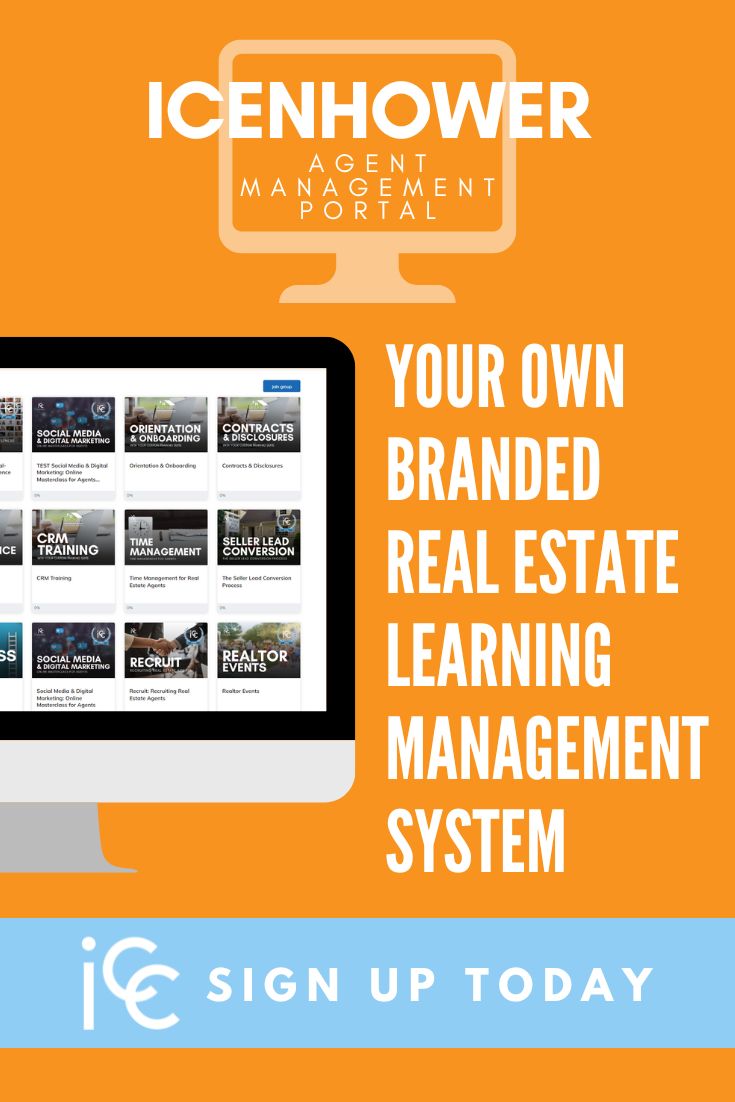
To be clear, this isn’t high-level, complex coaching. It’s usually about getting an agent’s social profiles set up, building out their sphere of influence, pulling contact information from their phone and social connections, setting people up on listing alerts, teaching scripts, and getting everything into the CRM. For more motivated agents, it can expand into prospecting — FSBOs, expireds, circle prospecting, door knocking. A lot of our clients use the systems already built into the agent management portal (AMP), so the coach — or the agent, watching alongside them — works through structured training while the brokerage holds them accountable through a dashboard tracking weekly activity.
This is also how you finally get agents actually using the CRM, and using it from day one — instead of blaming the CRM itself six months later, when the real issue was never the tool.
That accountability might start one-on-one and shift to a group setting once you have enough people in the program, with everyone tracking contacts made and additions to their CRM database. There can even be a dedicated bootcamp for brand-new agents — our New Agent Blueprint course is a good example — that gets them up to speed quickly before shifting into ongoing activity accountability.
None of this is complicated content. It’s just time-consuming. Building out a full contact database from someone’s phone and social connections can take the better part of a year if you’re only adding a handful of contacts a day. And most agents don’t do it: it’s estimated that only about 3% of agents in any given association of Realtors have an actually updated sphere of influence in their CRM. Most are just posting on social media occasionally, wondering why production goes up and down with the market, with no idea they’re not staying top of mind with anyone. Part of the problem is that agents mostly just copy what other agents post on social media, without seeing the other, less visible work successful agents are doing behind the scenes.
Compensating a coach for experienced agents works differently. I’d lean toward a voluntary, opt-in program with lighter compensation — maybe a 5–10% split, since it’s harder to sell a 50/50 structure to an established producer, or a flat fee, such as $500 per closing. Often the productivity coach will draft their own agreement directly with the agent, renewed annually, for a defined term. Just be careful here — if a coach gets too aggressive about enforcing that agreement when an agent wants to leave for a team or another office, it can create real drama, including threats of small claims court. Set expectations up front to avoid that.
I’d still promote this heavily at a high level, because plenty of experienced agents eventually leave a brokerage for exactly this reason: “I’ve been doing this fifteen years and I still don’t have a real database — I need to automate this.” Instead of losing that agent, offer them a coach right there in the office, paid only when they get paid, on a six-month or one-year term they can opt out of anytime.
This also rounds out your productivity coach’s own skill set — they get to work with bigger producers on higher-level strategy, like properly farming a neighborhood instead of sending out the occasional mailer, or building out an already-solid sphere of influence even further.
As the broker-owner, push this hard. Give the coach the platform — success stories at sales meetings, real visibility — and make it clear they also need to go out and generate their own clients for the program. Between the two of you promoting it, this creates a genuinely production-centered culture in your office, built around real success stories, which is exactly what people want to see and hear.
I strongly recommend this position if you want to increase agent production and actually follow through on what you’re promising at the recruiting table. If you’re worried agents won’t want to give up a piece of a split, that usually means the value isn’t being communicated well enough — because agents move brokerages for increased production all the time, even if they don’t always say so directly. Build this role, communicate the value clearly, and your retention will improve more than you’d expect.
Audience question: Would there be a place to have more than one productivity coach in a brokerage?
Yes — once a coach starts getting overloaded and can’t take on more clients, it’s very easy to bring in a second coach with their own split, and let the first coach run her own small team. I’ve seen this happen a lot. Once a coach gets to that point, they’ll almost always start voluntarily giving their own clients to newer agents and effectively run their own team from within that role. It happens almost every time.