Most agents who download a real estate business plan template never open it again after January. In my experience, the plan is very rarely the problem. The problem is that nobody knows how to stay with it and work it over the course of a year. So this year you get the free real estate business plan template for 2027, the 1-3-5 framework behind it, and the part nobody teaches: the 20-minute weekly routine that actually gets the plan done.
Download the template below, then read the rest, because the template is the easy part.
Want to build your 2027 plan live with us? Join our free webinar, The One-Page Plan: Build Your 2027 Real Estate Business Plan, on Wednesday, November 4 at 12:30 PM Eastern (9:30 AM Pacific). Everyone who registers gets the Business Planning course from the Icenhower Institute, a strategy call with a coach, the resources kit, the recording, and attendee access to our new 1-3-5 Plan Builder tool.
VIDEO: Real Estate Brokerage Business Plan PDF Free Download
Why your real estate business plan template fails by February
Here is something we do not like to admit in this industry. Our natural default is to wake up every morning and get done with work that day as soon as possible. It is why agents skip training videos and hate every CRM, even though every CRM is a hundred times easier to learn than the MLS. Every agent knows the MLS because existing clients need it. The CRM is extra work, so it stays empty.
A business plan is the same thing. It is a whole bunch of extra work you want to get done next year, work you have been unable to get done so far. From what I have seen, it is one out of a thousand agents who can make themselves do extra work for a full year without accountability. Lots of people can do it for a week, usually because they are out of money. Then the money comes in and they drop it all. Volatility is the enemy of success in every business. The steady person wins, and accountability is what creates steadiness.
So before you fill in a single box, accept two things. One, the plan is extra work. Two, you need something in place that makes you do it. Everything below is how.
The 1-3-5 real estate business plan template, explained
The format I use with coaching clients, and the format in the free download, is the 1-3-5 business plan. I did not invent it. We use it because it is simple and it gets everything on one page.
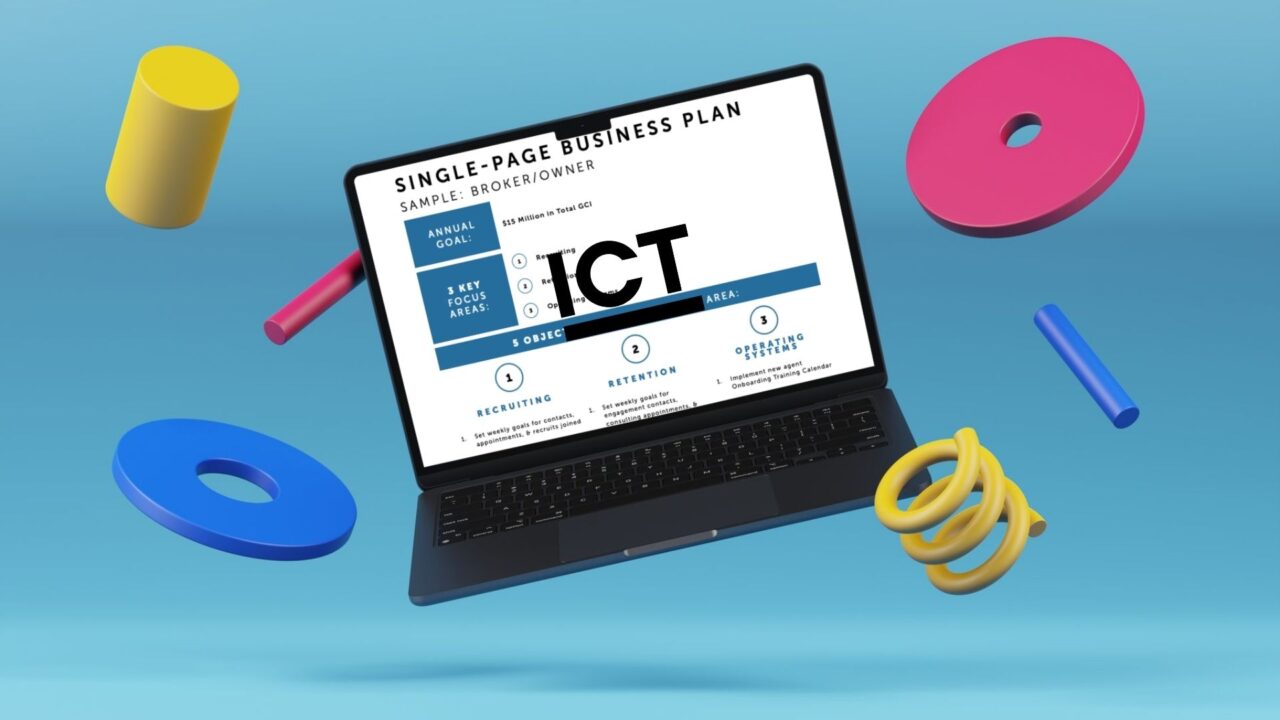
- 1 big goal. One numeric target for the year. A brokerage I have worked with set $15 million in total GCI. A solo agent might set 36 closed transactions.
- 3 focus areas. The three things that have to move for the one goal to happen. For that brokerage it was recruiting, retention, and operating systems.
- 5 objectives per focus area. Specific projects under each. Under recruiting: start tracking activity, set appointment goals, attend Realtor events, run social media marketing. Under retention: train more, build a productivity coaching program. Under operating systems: an onboarding calendar for new agents, engagement pipelines for the agents who stop showing up, two staff and training retreats a year.
That is 15 objectives, all pointed at one number. A 1-3-6 or a 1-4-5 is fine if you need the stretch, but go much past that and the plan becomes a to-do list, and you know what happens to those.
We have versions of the one-page template for solo agents, real estate teams, and broker owners, and all three are in the download at the bottom of this post.
Run every goal through the SMART test
Every line on the 1-3-5 has to pass the SMART test: Specific, Measurable, Achievable, Relevant, and Time-Bound. “Sell more homes” is a wish. “Close 36 transactions by December 31, 2027” is a goal you can track every Monday. Our Realtor goal setting worksheet walks through this for individual agents, and the team goal setting template does it for teams.
-
Quick View
Business Planning (Icenhower Institute)
$299ICT Online CourseBusiness Planning
Add to CartTurn your goals into a clear roadmap for real estate success.
Step-by-step guidance to create a customized business plan
Proven models for setting goals, tracking metrics, and driving growth
How to align daily activities with long-term objectives
Strategies to budget for lead generation, staffing, and operations
Tools to evaluate performance and adjust your plan throughout the year
Downloadable business plan templates, trackers, and worksheets

Measure What Matters
Use proven models to track metrics, budgets, and ROI for smarter decision-making.
Design a Clear Plan
Create a customized roadmap with ICT's famous 1-3-5 business plan with one, single-page document that connects your goals to daily activities.
Stay on Track Year-Round
Learn strategies to review, adjust, and adapt your plan to hit your targets consistently.
Designed for all learning types
Video Training
In-depth video training walking you through each module of the course, explaining the strategies, tips, and best practices for using Canva for real estate agents.
Written Workbook
Detailed and downloadable written workbook that provides you with a bullet point outline, summarized text, action steps, key takeaways, as well as space for taking notes.
Instructor Materials
Teach this course at your organization with the help of our downloadable presentation notes, presentation files, and Instructor's Manual.
Course curriculum
Enrollment includes access to the following course materials for 6 months
Business Planning 2023 Webinar Replay Intro to Business Planning- Introduction and Course overview
- ICC-Business-Planning-Guide
- The Dashboard
- ICC Team Dashboard Template
- ICC Production Tracker
- ICC Business Tracker
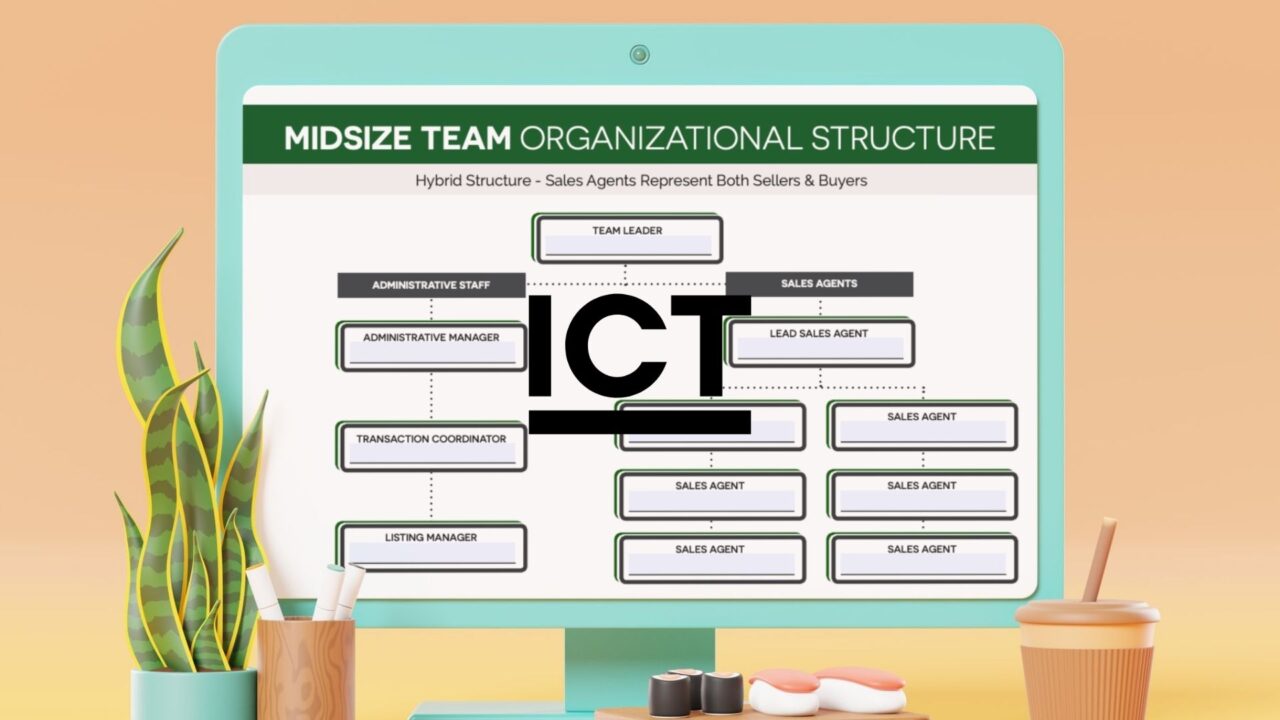
- Video: The Organizational Structure Chart
- Expansion Team Organizational Structure
- Large Team Organizational Structure – Hybrid
- Large Team Organizational Structure – Traditional
- Midsize Team Organizational Structure – Hybrid
- Midsize Team Organizational Structure – Traditional
- Small Team Organizational Structure
- Video: Production Growth Budget Schedule
- Real Estate Budget Schedule (example)
- Real Estate Budget Schedule (fillable)
- Sample Profit & Loss Statement
- Video: 1-3-5 Single Page Business Plan
- ICC-Business-Planning-Guide
- 1-3-5 Word Doc Editable
- Solo Agent Single Page 1-3-5 Business Plan – Sample
- Solo Agent Single Page 1-3-5 Business Plan – Fillable
- Team Single Page 1-3-5 Business Plan – Sample
- Team Single Page 1-3-5 Business Plan – Fillable
- Broker/Owner Single Page 1-3-5 Business Plan – Sample
- Broker/Owner Single Page 1-3-5 Business Plan – Fillable
- Virtual Listing Presentation Templates
- Virtual Real Estate Listings – How REALTORS Conduct Virtual Consultations
- Promoting Virtual Broker Open Houses Using Social Media
- Example of Successful Real Estate Marketing Video: The Future of Real Estate is Now
- Example of a Real Estate Buyer Presentation: The Virtual Consultation Process
- Virtual Showing Request Form
- Video: The Schedule and Conclusion
- Daily Schedule for Realtors
- Personalized Schedule Fillable
- Quarterly & Mid-Year Review Form
- Bonus Module Workbook: The 10-10-5 System
- BONUS HELP: Stock Photo Download
- BONUS HELP: How to Use Canva Tutorial
- BONUS HELP: How to Find Royalty Free Images
About this course
- $299
- 41 lessons
- 2.5 hours of video content
What Makes Our Business Plan Different?
We get specific and walk you through the entire process. You'll learn:
- How to build a single page business plan
- How to define your “Number One Goal”
- What 3 Strategies you need to Focus on to get to the One Goal
- How to prioritize and implement
- Steps for success for Solo Agents as well as Teams and Brokerages
Reviews
"I use ICT systems, the Icenhower Institute, and the coaching program to coach and train my team of over 30 agents. I use the ICT dashboard systems to keep my entire team accountable for their activities and set proper expectations."
Jake Rockwell
Over 500 Units Sold Annually
"I have coached with ICT for over five years. ICT has helped me quadruple my luxury business through marketing strategies so that I receive listings and sales through lead generation and multiple pillars of income."
Dennis Adelpour
Luxury Agent - West Los Angeles
"When we started coaching with ICT we worked all the time with some degree of success. Now, seven years later, we have grown to have the #1 market share in our area, we more than tripled our income and production, while also improving our work-life balance to enjoy our personal life with family and friends."
Tammi Humphrey
#1 Market Share & 100 Million in Annual Sales Volume
InstructorBrian Icenhower.
Brian Icenhower is the CEO and Founder of Icenhower Coaching & Consulting (ICC), which provides customized coaching and training programs to many of the highest producing real estate agents, teams, and brokerage owners in North America. This progressive company also produces online courses, podcasts, training materials, white label training portals, speaking events, video modules, and real estate training books. ICC is one of the largest real estate coaching companies in the world with thousands of clients and a large team of the most accomplished coaches in the industry.
Brian Icenhower is also the creator of TheRealEstateTrainer.com, the world’s leading production training website for real estate agents with well over 100,000 subscribers. As a best-selling author, Brian Icenhower has written a large number of books on real estate topics like recruiting, prospecting, geographic farming, hiring talent, house flipping, real estate administrative systems, sales communication and behavior, building a sphere of influence, and coaching for business performance. His most recent book, The High-Performing Real Estate Team, continues to top the Amazon bestseller list.
Brian Icenhower began his career in real estate as a top-producing real estate broker in the early 1990s until launching and operating a number of production-focused real estate offices in California and the Midwest United States. His implementation of extensive real estate productivity coaching, training, and recruiting programs has propelled these companies to be repeatedly recognized as some of the highest producing and fastest growing offices in North America by a number of major industry media sources.
Throughout his 30-year career in real estate, Brian Icenhower has also opened and operated various escrow and title companies, real estate licensing schools, property management companies, commercial real estate divisions, and mortgage companies. He also regularly serves as a keynote speaker and presenter for many of the largest real estate companies and organizations in the United States. As a result, Brian Icenhower has become one of the most recognized names and authorities in the real estate industry today.

Real estate business planning made easy.
This course takes the mystery out of real estate business plan and guides you through the entire process. It includes information and helpful templates for both solo agents and teams of varying sizes and structures. Add to CartTalk to a coach
If you've been considering hiring a coach, now's the time. Book a FREE coaching consultation session with your purchase of this course! Book Your Call

See all courses
-
Quick View
1×1 Solo Agent Weekly Coaching Program
$1,000 / monthThis 1×1 Solo Agent Weekly Real Estate Coaching Program designed to help you increase your production and your commission income with strategies and systems for sustainable business growth.
How to actually work a real estate business plan: 20 minutes a week
Here is the part missing from every real estate business plan template you have ever downloaded, including ours until now. Once the 1-3-5 is built and rolled out, it runs on one rule: 20 minutes, every single week, protected.
If you are a broker owner or a team leader, you already have a weekly staff or leadership meeting. Take 15 to 20 minutes of that hour for the business plan. You can still run your dashboards, your inventory pipeline, and your sales meeting training. We are taking one small sliver of the week for growth, and we are guarding it.
Inside those 20 minutes, here is exactly what you do.
Step 1: Prioritize all 15 objectives
List the 15 objectives in order of importance, one to 15. This is the first thing, before anyone touches anything. Most plans die right here, because everything is a priority, so nothing is.
Step 2: Pull down two or three at a time
Do not start all 15. Pick two or three, depending on how many people in the room can carry a project on their own. I am rarely pushing four at once. Things get stuck, you wait on people, and you want something else moving while you wait.
Step 3: Assign a baby step so small it cannot fail
Each project leader leaves the meeting with one task so microscopically small it can certainly be done by next week. Not “launch a geographic farm.” More like “find out what the best lead sources are and report back Tuesday,” or “ask our coach where to start.” If the answer comes back useless, fine. You tried, the group gives you three more ideas, and three people report back next week.
The test for every assignment is one question: what is so small that I can get it done by next week’s meeting?
Step 4: Open next week’s meeting with “Did you do it?”
Because you wrote down the step and the name, next week’s agenda is set. Did you do it? Great. What is the next step? Write it down. That is the whole meeting. Growth comes slowly, then suddenly. The first weeks are slow because you are finding the person who can tell you how. Then it moves fast.
Step 5: Cross it off and pull the next one down
When an objective is complete (say, every agent has picked a farm and a contact plan after taking the geographic farming course as a team), put an X through it. Fourteen to go. Pull priority number four down. A good coach running this with a client usually has the whole 1-3-5 done by June or July. We have built second-half plans more than once.
-
Quick View
Time Management for Real Estate Agents (Icenhower Institute)
$149ICT Online CourseTime Management
Add to CartTake control of your schedule, increase productivity, and create more balance with time management systems designed specifically for real estate agents.
-
Learn how to time-block effectively to focus on lead generation, client care, and personal growth
-
Discover the daily habits and routines that top producers use to stay consistent
-
Gain strategies for prioritizing tasks, minimizing distractions, and working efficiently
-
Build a weekly schedule that aligns with your goals and supports sustainable success
-
Understand how to track progress, measure performance, and stay accountable
-
Includes daily planner templates, time-blocking calendars, and productivity checklists

Own Your Schedule
Learn proven time management strategies that maximize focus and minimize burnout.

Work Smarter, Not Harder
Structure your day around high-impact activities that drive business growth.
Create Balance
Build routines that support productivity, profitability, and personal well-being.
Designed for all learning types
Video Training
In-depth video training walking you through each module of the course, explaining the strategies, tips, and best practices for using Canva for real estate agents.Written Workbook
Detailed and downloadable written workbook that provides you with a bullet point outline, summarized text, action steps, key takeaways, as well as space for taking notes.Instructor Materials
Teach this course at your organization with the help of our downloadable presentation notes, presentation files, and Instructor's Manual.Course curriculum
Enrollment includes access to the following course materials for 6 months
Course materials
- Time Management for Agents
- Video: Time Management for Agents
- Resource: Goal & Milestone Exercise (Fillable)
- Resource: Goal & Milestone Tracker (Fillable)
- Resource: Daily SOI Contact Form (Fillable)
- Resource: 4-Week Schedule (Printable)
- Resource: End-of-Week Debrief (Fillable)
- Resource: One Day, 20 Contacts (Fillable)
- Resource: Ways to Make Habits Stick
- Resource: Lead-Tracking Sheet (Printable)
- Resource: Personalized Schedule (Printable)
- Resource: Prospecting Accountability Chart (Printable)
- Resource: Sample ICC Year-to-Date Check-Up Form
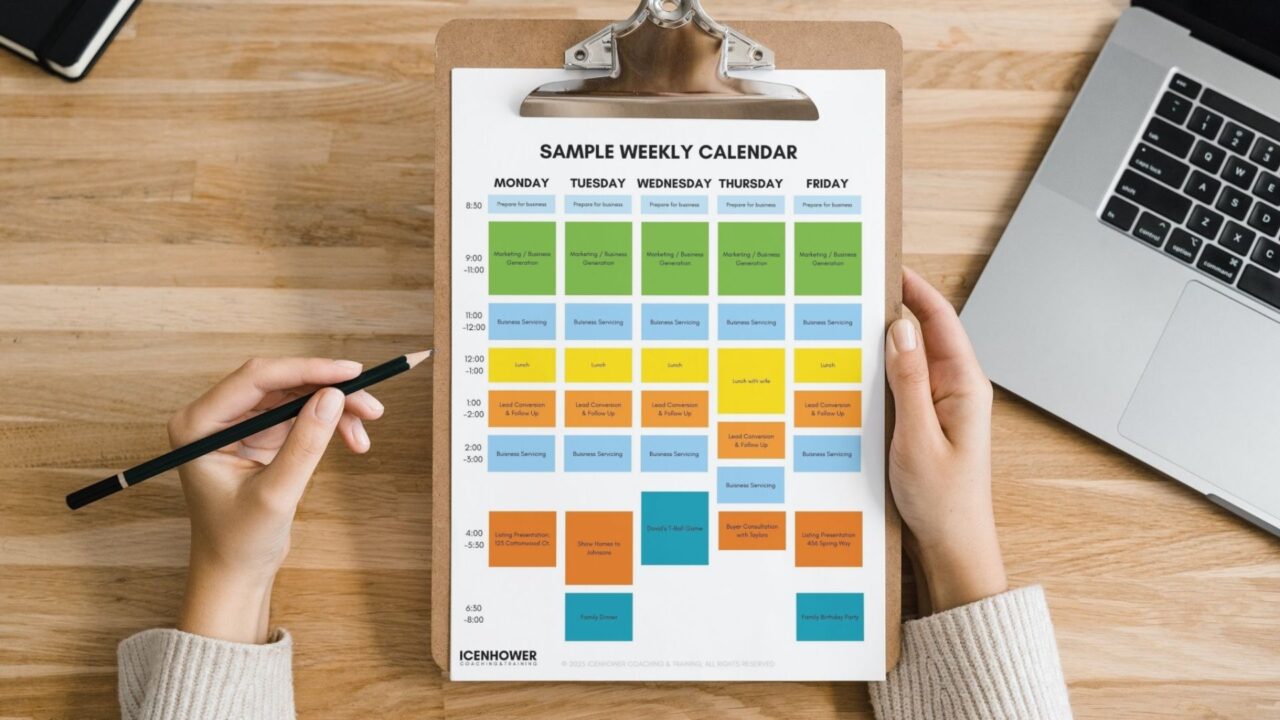
- Resource: Sample Weekly Calendar
About this course
- $149
- 17 lessons
- .5 hours of video content
Reviews
"I use ICT systems, the Icenhower Institute, and the coaching program to coach and train my team of over 30 agents. I use the ICT dashboard systems to keep my entire team accountable for their activities and set proper expectations."
Jake Rockwell
Over 500 Units Sold Annually
"I have coached with ICT for over five years. ICT has helped me quadruple my luxury business through marketing strategies so that I receive listings and sales through lead generation and multiple pillars of income."
Dennis Adelpour
Luxury Agent - West Los Angeles
"When we started coaching with ICT we worked all the time with some degree of success. Now, seven years later, we have grown to have the #1 market share in our area, we more than tripled our income and production, while also improving our work-life balance to enjoy our personal life with family and friends."
Tammi Humphrey
#1 Market Share & 100 Million in Annual Sales Volume
Instructor
Brian Icenhower.
Founder & CEO of Icenhower Coaching & Consulting Founder/CEO of one of the world's largest real estate coaching, training, and education companies. ICC is also a leader in online training courses, systems, and company-branded websites for agent and brokerage training and onboarding.
Take control of your time and transform your productivity.
Add to CartEnroll in Time Management for Real Estate Agents (ICT) to master scheduling, time-blocking, and accountability systems that help you work efficiently and achieve your goals. Build the structure and consistency that top agents rely on for lasting success.
Start mastering your time today.Talk to a coach
If you've been considering hiring a coach, now's the time. Book a FREE coaching consultation session with your purchase of this course! Book Your Call
See all courses
-
-
Quick View
1×1 Solo Agent Weekly Coaching Program
$1,000 / monthThis 1×1 Solo Agent Weekly Real Estate Coaching Program designed to help you increase your production and your commission income with strategies and systems for sustainable business growth.

The 50-ideas rule: what to do with every shiny object
You will get about 50 good ideas a year. One of our coaches brought us a new class idea the day I recorded this video, and I love it, and we are going to do it. But it goes on next year’s 1-3-5, not this week’s calendar.
Here is why. Salespeople are volatile. We squirrel after whatever is exciting and justify it as necessity. A new brokerage opens with a new split, so we change ours. Business is slow, so we buy leads we never work. That is acting like a salesperson, not a business owner.
The rule: write the idea on next year’s list. In October, see if you are still excited, and weigh it against every other shiny idea from that year. If it still earns a spot in the top 15, you get to it. Most will not. The companies that move this slowly are big for a reason. Stop needing everything yesterday.
If you are a solo agent: the plan needs a second person
I will be blunt about this. A solo agent with a 1-3-5 and nobody checking on it almost never gets it done. In my experience it is one out of a hundred, maybe one out of a thousand, who pulls that plan out every week and keeps pushing it forward on their own.
That is what a coach is for, and it is also how you should judge one. A good coach has your business plan open every session, and what they coach you on each week is the next baby step on one, two, or three of your objectives. If your coach keeps bringing you new, exciting things to try, that is squirreling. If you show up with fires to put out and the plan never comes up, that is a bad coach. You will put fires out all year without help. What agents abandon is the growth, because growth is extra work.
You do not have to like the activities. You just need to want the results. That is the difference between agents who stay the path through a slow winter and the ones who change brokerages, lead sources, and coaches every time it gets uncomfortable. Consistency is the whole game, and it is the reason coaching matters most in a slow market.
If you want a coach in your corner for 2027, book a free coaching call and we will build your 1-3-5 together.
Your 2027 business planning checklist
- Download the one-page template below (agent, team, or broker owner version).
- Write one numeric goal, three focus areas, and five objectives under each. Run every line through SMART.
- Rank all 15 objectives.
- Pull down the top two or three and assign a baby step for each, due next week.
- Block 20 minutes in your weekly meeting or coaching call and never give that time away.
- Start a “next year” list for new ideas and leave it alone until October.
- Register for the November 4 webinar and build the plan live with us.
Download your free 2027 real estate business plan template
Fill in the form below and we’ll email you a zip with six files: three sample 1-3-5 plans (agent, team, and broker owner) so you can see a finished plan, plus three fillable forms to build your own. If you run an office, pair it with the brokerage business plan PDF.
Then come build it with us on November 4. Register for the free webinar, watch the full video above, subscribe to the ICT channel, and follow Icenhower Coaching & Training for a new training every week. The template is free. The 20 minutes a week is on you.
Video Transcript
Prefer to read along? Here’s the full transcript from this training video.
Brian Icenhower: Let me show you how we should be coaching business planning, because business planning is a big problem. A lot of people hate business plans because they build them and they never use them. So how we implement them is the key. The business plan is very rarely the problem. The problem is people don’t know how to stay with it and work it over the course of a year.
And that is really only going to happen with a coach or a leader holding someone accountable. If someone thinks they’re going to do that on their own, they are kidding themselves. Here’s why. A business plan is a whole bunch of extra work that you want to get done next year, work you’ve been unable to get done so far. And usually it’s so much work that it takes an entire year to get it all done.
We in the real estate industry don’t realize this, and if we don’t realize it, we’ve got a big problem. Our natural default position is to wake up every morning and get done with work that day as soon as possible. That is our natural default. It’s why agents don’t want to spend extra time in the CRM. That’s extra work, and it keeps them at work longer. They don’t want to watch training videos. That’s extra work. They want to work from 10 to 3 and pick the kids up at 3, and if they can get done by 1, that’s even better.
So they’re jamming to get all the work on their pending transactions and pending clients done as quickly as possible. That’s all the business they’ve already got, though. That’s rear view mirror stuff. They’re not doing anything to get new business, grow their business, or enhance their career. The natural default is just to be done as fast as possible every single day.
That’s why people always ask, “Why can’t I get my agents to use the CRM?” Because they don’t want to do it. They want to get done earlier each day, and the CRM is extra work. They look at work as handling their current clients’ needs. They never put time into getting new clients, or into training, or into working the CRM. That’s why they all hate CRMs, despite the fact that every CRM is a hundred times easier to learn than an MLS software program. The MLS is clunkier, harder, and less intuitive, but every agent knows how to work it. Why? Because that’s what their existing clients need. They need you to input a listing and search for property. But when it comes to a CRM, it’s “Oh no, it’s too hard.” That has nothing to do with the software. It has everything to do with the fact that it’s extra work, and I’m looking for an excuse not to do it.
So the quicker we can be self-aware that we’re just trying to work less, the better off we are, because then we can do something about it. And business planning is exactly the same thing. On a business plan you typically have a large group of things you need to do next year to get where you want to go. That is all extra work. So the idea of doing that extra work without accountability is crazy.
It’s one out of a thousand agents who can make themselves do extra work for an extended, continuous period of time. There are a lot of people who can do it for short periods. “I’m motivated today, I’m going to get it done.” Or “I’m out of money, I need to get money.” There are tons of people who will work when they have no money, but once they get some money, they drop it all and ride that roller coaster of up, down, up, down. Volatility is the enemy of success in all business. It is the steady person who can hold it.
That’s what accountability does. Putting accountability in place is what creates that steadiness. The person who always goes to the gym, always eats healthy, always lead generates. Those are the tortoises that win the race over all the rabbits that are up and down. You’ve worked with someone who’s volatile before. I’ve been volatile before. It’s not pleasant. So learn to get self-aware and understand that it’s really just laziness. “I don’t want to work. I don’t have time.” Be aware of that. We’re naturally lazy people by nature, so being self-aware that we need to put things in place to make us do extra work is absolutely crucial.
A business plan is just that. It’s extra work. So we have to, A, be aware of that, and B, put some accountability behind getting it done.
I’ll give you an example. A business plan format we like to use, because it is very simple and it does get it all done, is the 1-3-5 business plan. Yes, we copied it from lots of people. I didn’t make this up. It’s well accepted out there in the industry. Here’s one for a broker owner. This brokerage’s leadership team has a goal of doing $15 million in total GCI. That’s their one big goal. Then they have three focus areas: recruiting, retention, and operating systems. They want to increase recruiting, increase retention, and implement a bunch of new operating systems. So your one is at the top and your three are below it. Then we have five objectives for each of those three focus areas.
In this case there are different objectives for recruiting. We’re going to start tracking things, set goals for appointments, attend some Realtor events, do some social media marketing. Here’s retention: different things we could do to increase productivity in the office, train more, create a productivity coaching program, and so on. Operating systems: they want to start using an onboarding calendar for their agents, implement engagement pipelines for the agents who aren’t showing up a lot, and hold a couple of biannual staff and training retreats. Things you’d expect to see. So there’s your one, your three, and your five.
We have different examples of that for real estate teams and for individual agents. I just showed you a brokerage owner’s because we have a lot of brokerage owner clients. Here’s the key, though. Once you get a 1-3-5 business plan done, and typically when we’re working with our clients we have them do a rough draft and then we, the coach, edit that rough draft with them and help them finish it. Then we take it to a leadership team, if our client has one, and let them make some edits. Then we possibly roll it out to the entire office. If it’s 500 agents I may not roll it out to everybody, but I’ll show everybody: here’s what we’re working on this year. That way they see that you’re working and growing too, and we encourage the agents to do the same thing for their own businesses. We lead by example.
I can tell you right now, our company has a 1-3-5. We meet on it every single year, and we don’t do things impulsively. We get ideas about good things all the time. In fact, one of our coaches gave us an idea for a new class just today, and I’d love to jump on it right away, and we are going to do it. But it’s going to go on the 1-3-5 business plan, if everybody agrees it’s a priority for next year. Because we get something like 50 different ideas every year.
We can’t just drop everything we’re doing right now and be impulsive like a real estate agent and say, “Oh yeah, let’s do it, I’m fired up on this.” I’ve been in organizations like that. They’re usually run by volatile people, up and down. Nothing ever gets done. We scrap things all the time and never see them through. It needs to be a systemized, process-based stability. So we put the idea on the 1-3-5 and weigh it against all our other plans and ideas to see which ones are the real priority. What can we get to first? There’s always a big list every single year in a business.
What happens is we never see a plan through, because, number one, we aren’t constantly looking at it and working on it, and we’re going to talk about how to do that. And number two, we abandon half of those items because we squirrel after new things that come up and excite us throughout the year. We always justify them by necessity. “This new company opened up and they have a new commission structure, so we’ve got to change ours.”
We get very reactive because we’re volatile creatures. In real estate, salespeople are just volatile. They operate off full emotion without any type of constraint. So we jump after impulsive things. We buy something because we don’t have any business. “I need some leads, I’m going to pay for this marketing.” And the vast majority of the time, we don’t end up using it. We don’t act like we’re running a business. We act like salespeople.
So what we say is, no, we’re going to get through our plan for this year. We’ll put that idea on our list for next year’s 1-3-5. At the end of the year, if we’re still excited about it, we’ll see if it earns a spot in our top 15 objectives. Remember, there’s one, three, and five, and those five are different objectives for each of the three focus areas. So there are actually three times five, 15 things we’re going to work on over the course of a year. If the idea is still in the top 15 by priority, we get to it. Not a rush.
I know that’s hard for a lot of real estate agents, because they love to be impulsive and don’t want to wait for stuff. They don’t like the bureaucracy of big companies that move too slow. Those big companies are really big and their owners are rich for a reason. So get over yourself. Stop acting like the low guy on the totem pole in the org chart and needing everything yesterday. You’ve got to be self-aware enough to know that impulse is crazy just as often as it’s smart, and you’ll justify anything to yourself if you get excited about it. The key is to put some accountability in place so you don’t do that.
So we move slow and go after our priorities every single year. Otherwise you’re just going to create a to-do list every year, and you’re never going to have time to do anything on it, like most people never do with to-do lists. We put things on a to-do list and feel good, even though we’re totally aware we’re never going to do anything on that list, because we always want to get done early every day. It’s madness we put ourselves through.
So here is the way a 1-3-5 should operate, and it’s really simple. Once the 1-3-5 has been vetted by everybody in the organization and rolled out, if you’re a broker owner, I would certainly hope you have at least a staff or leadership meeting every single week. If you’re a brokerage owner, you probably have either a combined staff and leadership meeting or separate ones, depending on how big you are. If you’ve got 500 agents, you might have a lot of staff, and not every one of them needs to be in the leadership meeting. But most aren’t that big. If you’re not that big and you’ve just got the people on staff, that is your office leadership, and we’re going to meet.
In a portion of that weekly meeting, let’s say it’s an hour long, I would dedicate 15 to 20 minutes every single week to at least one to three of the 1-3-5 items. When I talk about the items, we’ve categorized 15 objectives at the bottom, based on the three focus areas, which are directly aligned to meeting the one numeric big goal at the top. Now, you could have a 1-3-6, or a 1-4-5. I’m fine with stretching it a little bit, but we don’t want too many or it just gets burdensome. Let’s say we’re using the standard 1-3-5.
The first thing I’m going to do once I’ve got my 1-3-5 together is prioritize. I want to list the objectives one to 15 in order of importance. That’s the first thing. One to 15. Then I’m going to select two or three of them to start working on right away. And we’re going to push the ball forward in baby steps every single week.
It’s really simple how you do it. Whether we pick two or three depends on how many people are in this meeting who can get the work done. If I’ve got six people in there, and I can assign one task to one person who doesn’t need much from anybody else, that person can pretty much drive the project through. Then the next person takes another. Maybe I can pull three down at once. I’m not usually pulling four down at once, two or three. I push a few at a time because some things get stuck, we wait on things, and I want to be able to push something else through, because this is the 20 minutes a week I’ve got dedicated to growth as a group. That’s it. 20 minutes a week, and I’m going to protect that 20.
So the rule is, if you are the project leader driving one of those three projects, whether you’re a member of this leadership team, this real estate team, or a large team’s leadership group, you’re going to drive it forward. Your goal in that 20 minutes is: what’s the first thing we need to do to get this started? It might be to call another team, or talk to your coach, or talk to somebody who can tell us where to start. If we’re going to start lead generating, it might be “we need to find out what the best lead generation sources are. Who are we going to call?” It might be someone saying, “I’m going to ask ChatGPT what all the different lead generation activities for real estate agents are.” Great. Can you report back your results by next Tuesday’s meeting?
We have to pick a task for them, one they’re accountable to the group to complete, that is so microscopically small it can certainly be done by next week. We go forward in baby steps, because growth comes slowly, then suddenly. If we start making little baby steps, you’ll see it moves very fast as you get closer to the completion of each objective. So we always go slowly, then suddenly. We just have to start. You know how that works. Once you get something started, it starts to go, but we wait forever to get it started. So the key is just to get started. You start going slow, and then it moves very quickly.
Usually at the beginning we’re finding a who to tell us how to do this. That’s when it moves slow. We’re trying to learn which way to go forward. A lot of it is just reaching out to this person or that person. We come back: “I asked ChatGPT and what it gave us was no good.” Then we come back next week. At least you tried. You did something. Now the whole group can say, “Why don’t you try this? Why don’t you call this person? Why don’t you ask your coach this week?” You do that, and all three of you report back next week. With those three activities, I bet we have an answer. We’re just trying, and we’re going to keep trying. We’re not going to quit until we can check this off our box.
Let’s say we get all the way to the point where we’re going to start geographic farming neighborhoods, and we’re going to have each agent pick a farm. Then it’s “What’s the first step?” Let’s all start taking the ICT geographic farming course as a team so we learn how to do it. Maybe that’s it. Then once that’s done, we push it forward each week. When we start selecting farms and picking our contact plans for how we’re going to stay in front of the farm, we’re done. That objective is now complete. One of our 15 is done. I go back to the 1-3-5 and put an X through it. 14 to go.
Mind you, we pulled two or three down at once, so we’re also pushing those in the meeting. That 20 minutes is compact, because we’re trying to figure out the next baby step for two or three things in 20 minutes. That’s all we’re doing. What’s the next step? What’s the next step? Then we write down what the next step is and who’s going to do it. When next week comes, our agenda is already set for that 20 minutes. Did you do it? Great. Now we’ve got a whole team pushing to get a business plan done.
Does that make sense? And it’s only 20 minutes of your team meeting. You can still go through your dashboards. You can still go through your inventory pipelines. You can still do a training in there. We’re just taking a small sliver and dedicating it to our business plan each week. That’s it. All we’re doing is pushing it forward.
Now, if you’re a solo agent with a 1-3-5 trying to do this on your own, it’s extremely hard. I can tell you, very few get it done. I’d say one out of a hundred, one out of a thousand, actually pulls that plan out every week and keeps pushing forward in baby steps. That’s why you get a coach. You get a coach to push you forward. In fact, any good coach should have a business plan, and basically what they’re coaching you on every single week, by way of content, is your own business plan. That had better be the case, because you both agreed to put this plan together.
If the coach is talking about new stuff, that shouldn’t be happening. That’s squirreling. A good coach should hold you to what you both agreed to on your business plan, and every week we should be pushing you forward on the next baby step for one, two, or three items. If you come to that coach with a bunch of fires to put out and problems to deal with, and we get off your business plan and don’t keep pushing it forward, that’s a bad coach. The coach is going to keep you focused on growth. I’m not worried about you putting out fires. Real estate agents do that all year long by themselves without any accountability. What they abandon is the growth. Why? Because it’s extra work and they want to go home early.
So the coach should never have to worry about what to talk about. The coach is not there to entertain you and give you new, exciting things that motivate you. The coach is there to make you do the work you already agreed to do. And yes, it’s not fun. The coach is not there to be your friend or a shoulder to cry on in lieu of this. They can do those things, and I’m okay with it, but I’m not excited about it. What I’m really excited about is whether we can get you to stick with the plans you both agreed to, despite the fact they may be boring every single day. You don’t have to like the activities. You just need to want the results.
Staying the path, keeping the focus without jumping around to different things, moving companies, changing lead generation methods, changing coaches, changing leaders, changing everything. That’s the volatility that leads to failure. It’s the people who can stay the path who win. Especially in slow markets, especially in seasonality and winter, everybody just can’t stand the pain and has to make a flip flop. A good coach keeps you on the path so we stay in growth, and that’s really what you should be working on.
A good coach should have you through a 1-3-5 probably by June or July, halfway through the year. We’ve had to do that many times, where we actually create a second-half 1-3-5 because we’re chugging forward so well. It’s baby steps every single week until it gets done. If you get to the end of the year and it’s not all done, we combine what’s left with the list of ideas we held back on and didn’t react to, the ones we were going to wait and see about. Do we still want to do those, or are these 15 things better? That’s why in October, November, and December, coaches should be talking with their clients all about business planning for next year. It’s that important. We architect the path forward together, and then the coach has to keep you on it when you get distracted by all the other things that want to take you off it.
Our coaching company does the exact same thing. We get lots of neat ideas, and some people in our organization don’t like that it takes forever to act on them. It’s because we get so many of them, and we’re really committed to this year’s plan. So we put the idea on the list for next year and see if it makes the top 15. You should do the same with your business. When we’re really excited about something, we certainly want to do it right now. Give it a couple of weeks and see if you’re still excited about it. Weigh it against all the other bright, shiny ideas you came up with, and you’ll start to realize, “Wow, I do a lot of this kind of stuff.”
That’s what coaching is. Little baby steps and little chunks. Once we mark that X off, we pull the next one down. What’s priority number four? We start pushing the ball forward on it. Then we mark another one off and pull number five down. We’re always pushing two or three forward at a time in baby steps. What is so small that I can get it done by next week’s meeting? That’s the test. What is so small that I can get it done by next week’s meeting?
You usually have one leader pushing a project, but not always. Sometimes the project moves into a different area. Now we’re implementing with the team, so it moves to the person whose job that is. Just make sure someone is pushing it forward, and hold that person accountable to the baby step each week. You’ll watch how fast it starts to get done after a while. That’s how we get a business plan done. It’s through accountability. It’s through teamwork. It’s through a coach. It’s not the plan, it’s the implementation. Thanks, guys.