Real estate transaction coordinator training made simple: Brian Icenhower's I, We, They process for letting go of tasks so they never come back to your desk.
Most agents who hire a transaction coordinator never really let go. They hand over a few files, take a few back, and six months later they are still doing the work they hired someone to do. The problem is almost never the hire. It is the real estate transaction coordinator training, or the lack of it.
I use a simple process to fix this. I call it I, We, They. It works for a single task, like a CMA, and it works for an entire job. It is how a team leader gets confident enough to let go, and how a talented new coordinator earns the right to take work off your plate without it boomeranging back.
Here is how it works, and why you should show it to your new hire on day one.
VIDEO: Real Estate Transaction Coordinator Training: The Letting Go Process
The I, We, They Process for Real Estate Transaction Coordinator Training
Every task you hand to a transaction coordinator or administrative assistant goes through three phases.
1. I do it (they watch)
You do the task while they watch. Three to five times is typical for anything complex. Nowadays you don’t sit side by side and hope they take good notes. You record it. Share your screen, walk through the task out loud, and save the video.
That recording becomes a training asset for this hire and every hire after. That is what I mean when I say systematize via video, not via paper. A checklist tells someone what to do. A video shows them how you like it done.
2. We do it (they prepare, you edit)
Now they do the work first, and you review it before it goes anywhere. You correct mistakes, you explain why, and they do it again. You keep going, three times or five times or however long it takes, until the work stops needing your edits.
This is where the coordinator becomes what I call the laboring oar. They are doing the work. You are only checking it.
3. They do it (you let go)
Once the edits stop, you stop checking. They own it. Pretty soon you rely on them completely, and that task is off your plate for good.
A Real Example: Letting Go of the CMA
One of the toughest tasks for agents to let go of is the comparative market analysis. Most agents never give the CMA to any type of assistant. It feels personal. It is your pricing, your listing appointment, your reputation on the line.
But somebody taught you how to prepare a CMA. It is not that hard. We are just afraid to train it.
So run it through I, We, They:
- I: Prepare three to five CMAs on a recorded screen share while your coordinator watches.
- We: Your coordinator prepares the next ones. You edit each one before you use it, until it no longer needs your changes.
- They: You send an address and get a finished CMA back. You drop it in your listing packet and you’re out the door.
That last step is the whole point. When you are taking a lot of listing appointments, the time you get back is time you spend in front of sellers. If you’re working on your listing presentation skills, our post on pre-qualifying your listing appointments pairs well with this.
-
Quick View
ADMIN: The Training Process for Real Estate Administrative Assistants (Icenhower Institute)
$299ICT Online CourseADMIN: The Training Process for Real Estate Administrative Assistants
Add to CartMaster the systems and skills every real estate admin needs to support top agents and growing teams.
-
Training for key roles: Listing Manager, Transaction Coordinator, Office Administrator
-
Systems, checklists, and dashboards to streamline operations
-
Listing management from pre-listing through closing
-
Lead tracking and accountability tools
-
Strategies to free agents’ time for production
-
Downloadable forms, templates, and checklists
Create Structure & Systems
Learn how to implement checklists, dashboards, and tracking tools that keep your agents and business organized.
Master the Admin Role
Gain step-by-step training for listing management, transaction coordination, and day-to-day operational support.

Boost Team Productivity
Understand how to free up agents’ time by streamlining processes, ensuring accountability, and driving efficiency across the office.
Designed for all learning types
Video Training
In-depth video training walking you through each module of the course, explaining the strategies, tips, and best practices for using Canva for real estate agents.Written Workbook
Detailed and downloadable written workbook that provides you with a bullet point outline, summarized text, action steps, key takeaways, as well as space for taking notes.Instructor Materials
Teach this course at your organization with the help of our downloadable presentation notes, presentation files, and Instructor's Manual.Mergers & Acquisitions
Click to watch more about this real estate training course
Program curriculum
Enrollment includes access to the following course materials for 6 months.
Module 1: Introduction- Module 1 Workbook: Introduction
- Video: Communication Foundations
- Get to know the DISC Profiles
- Module 2 Workbook: Understanding Job Roles
- Video: Job Roles for Admin Staff
- The Solution Triangle
- Module 3 Workbook: The Administrative Manager
- Video: The Administrative Manager: Creating Structure
- Sample Weekly Calendar
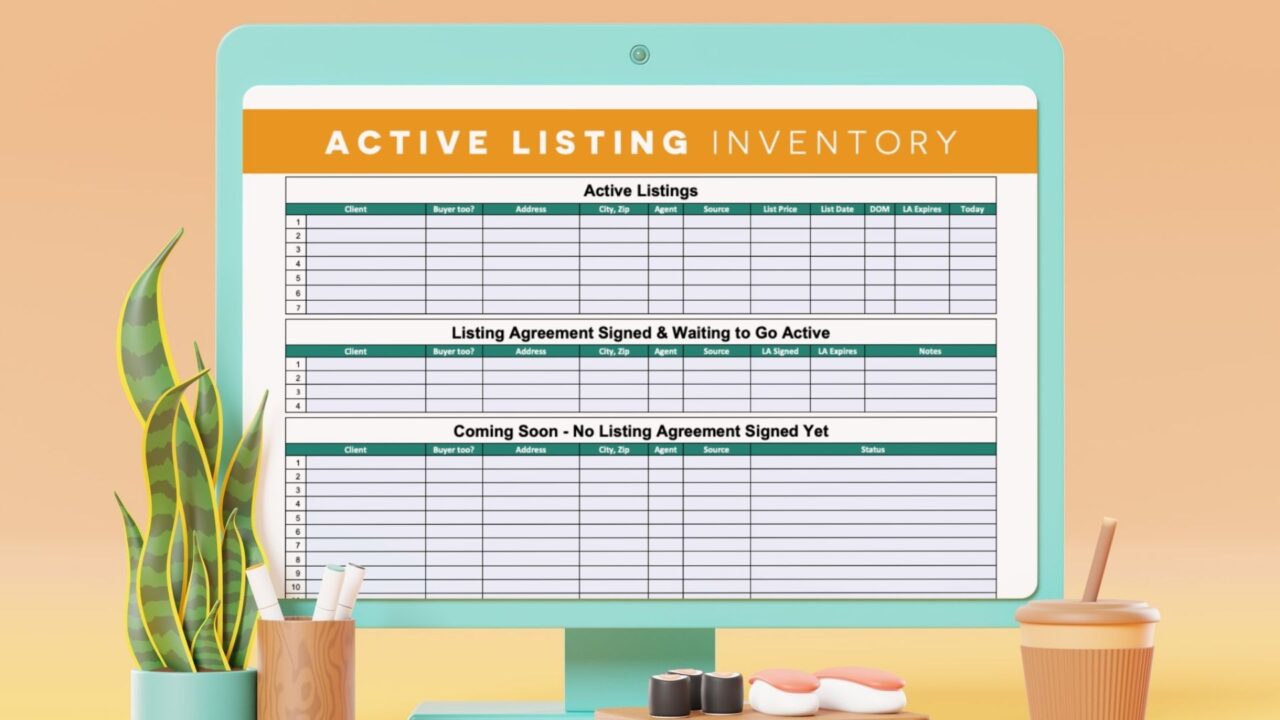
- Active Listing – blank (fillable)
- Sample Buyer Inventory
- Daily Contact Form (fillable)
- Sample Year-to-Date Check-Up Form 1
- Sample Year-to-Date Check-Up Form 2
- Lead Tracking Sheet (fillable)
- Sample Pending Inventory Pipeline
- Sample Dashboard 1
- Sample Dashboard 2
- Year-to-Date Check-Up Form (fillable)
- Active & Pending Inventory Lists (fillable)
- ICC Team Dashboard (fillable)
- Module 4 Workbook: The Listing Manager
- Video: The Listing Manager: From Listing to Contract
- Listing and Pre-Listing Checklists
- Listing to Contract Checklist
- Pre-Listing Checklist
- Seller Lead Sheet
- Assistant’s First Call Checklist
- Assistant’s First Call Checklist (fillable)
- Defining Moments in Real Estate Transactions
- Module 5 Workbook: The Transaction Coordinator
- Video: The Transaction Coordinator: From Contract to Closing
- Buyer-Seller Checklist
- Active Listing – blank (fillable)
- Buyer Closing Checklist
- Buyer Inventory
- Buyer Lead Sheet (fillable)
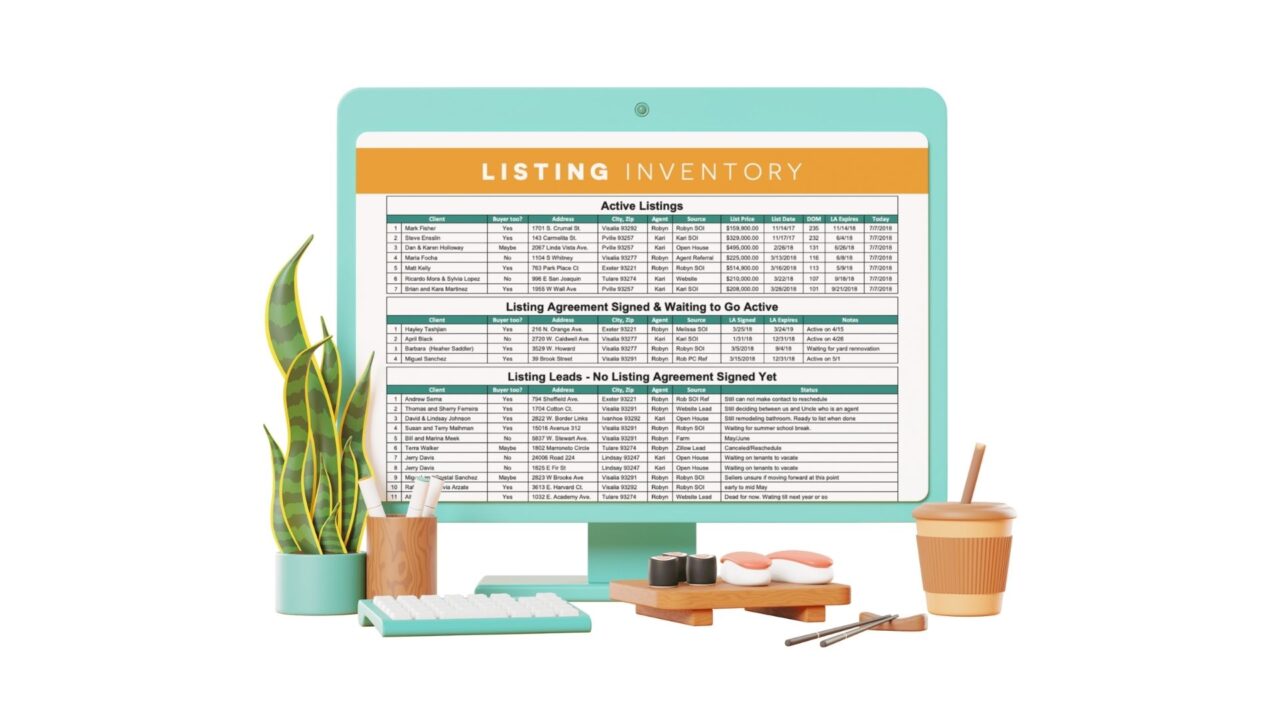
- Listing Inventory
- Pending Contracts – blank (fillable)
- Pending Inventory Pipeline
- Seller Closing Checklist
- Buyer and Seller Checklists (fillable)
- Module 6 Workbook: The Marketing Director
- Video: The Marketing Director: Building your real estate business
- Buyer Closing Checklist
- Client Event Contact Plan
- Listing to Contract Checklist
- Script: Contacting past and existing clients
- Pre-Listing Checklist
- Seller Closing Checklist
- Module 7 Workbook: Your Sphere of Influence
- Video: Your Sphere of Influence
- Team Scoreboard
- Graphic: The SOI Core
- Video: Enhancing the Client Experience
- Defining Moments in Real Estate Transactions
- Workbook: Managing Virtual Assistants & Remote Workers
- Video: Managing Virtual Assistants & Remote Workers
- Workbook: Creating the Ultimate Client Experience
- Video: Creating the Ultimate User Experience
- Policies and Procedures Handbook
- First Day Welcome Orientation Checklist
- First Quarter Checklist – Admin – alternate
- Editable First Day Welcome Orientation Checklist
- Workbook: Conclusion
- Video: Above and Beyond
- Leader vs Manager
- Production Growth Budget Schedule
- Staff Self-Performance Appraisal
- Sample Team Annual Business Plan
- Editable Blank Business Plan
- Editable Blank Action Steps

About this course
- $299.00
- 79 lessons
- 5 hours of video content
Reviews
"I use ICT systems, the Icenhower Institute, and the coaching program to coach and train my team of over 30 agents. I use the ICT dashboard systems to keep my entire team accountable for their activities and set proper expectations." Jake Rockwell Over 500 Units Sold Annually "I have coached with ICT for over five years. ICT has helped me quadruple my luxury business through marketing strategies so that I receive listings and sales through lead generation and multiple pillars of income."
Dennis Adelpour Luxury Agent - West Los Angeles "When we started coaching with ICT we worked all the time with some degree of success. Now, seven years later, we have grown to have the #1 market share in our area, we more than tripled our income and production, while also improving our work-life balance to enjoy our personal life with family and friends."
Tammi Humphrey #1 Market Share & 100 Million in Annual Sales Volume Instructor Brian Icenhower.
Having someone back in the office helps agents amplify their sales potential. They can focus on generating business, following up on leads, conducting appointments, and writing offers/negotiating contracts -- all things that create more income.
This 9-module course not only identifies the four key roles of a real estate assistant, but it also breaks down the precise workflows when serving as a listing manager, transaction coordinator, marketing director, and administrative manager.
Whether you’re an agent learning how to train your assistant, an assistant looking for your own training process, or you’re both reading through these materials together, this course provides the explanations and concrete examples of best practices in real estate offices so you don’t have to.

Make administrative tasks easy.
Whether you’re an assistant or a solo agent, systematizing adminstrative processes will increase your efficiency. This course gives you the strategies, tools, and techniques to master administrative processes so your agents are free to focus on generating, nurturing, and converting leads. Add to Cart Add to CartTalk to a coach
If you've been considering hiring a coach, now's the time. Book a FREE coaching consultation session with your purchase of this course! Book Your Call
See all courses
-
-
Quick View
1×1 Solo Agent Weekly Coaching Program
$1,000 / monthThis 1×1 Solo Agent Weekly Real Estate Coaching Program designed to help you increase your production and your commission income with strategies and systems for sustainable business growth.
Why I, We, They Solves Two Problems at Once
When you train a transaction coordinator this way, you are managing two opposite risks at the same time.
The team leader who won’t let go
This is almost always the case with the rainmaker. It is their clients, their business, and they like it done their way. I, We, They gives them a structured way to build confidence before they let go. They see the work done right, over and over, before they step away.
The talented hire who takes it too fast
Top talent wants to grab tasks. “I got this. I’ll take it off your plate so you can generate more business.” That is exactly the attitude you hired for, and you don’t want to squash it.
But if a task gets handed over before the training is done, mistakes follow. And here is the biggest frustration in real estate team operations: we let go, the task comes back, and we get so frustrated that we never let go of it again. A rushed handoff costs you that task permanently.
Real Estate Administrative Assistant Training Takes Time, and That’s Fine
I use an example of 30, 60, and 90 days on the I, We, They curve, but it depends on the task. Some tasks on your listing and closing checklists take one demonstration and they’ve got it. Others, like the CMA, take a lot of reps before you’re comfortable.
When we train an administrative assistant, we train each task on the listing checklist and the closing checklist this way, one at a time. You are not letting go of a job all at once. You are letting go of it task by task, in an order you feel good about.
The curve tracks two things. Management oversight starts high in the I phase, because you are basically doing it yourself. Independence starts low. Through the We phase those lines cross. By the They phase, your coordinator has full independence and you have stepped away.
Show the Curve to Your New Coordinator
This is the part most agents skip. I show the I, We, They curve to every new assistant, and here’s why.
Good hires don’t want to be micromanaged. And good leaders don’t want to be micromanagers. But you still need to train, and you still need to feel comfortable when you let go. Those two things pull against each other.
So I say it out loud: “I’m only going to micromanage you on this for a little while. That’s it. The faster we get through this process, the faster I let go.”
That one sentence changes the relationship. Your coordinator knows the close oversight has an end date. They know the fastest path to independence is to listen during the I and We phases. And you have permission to train properly without feeling like a micromanager.
-
Quick View
DISC: Understanding Behavior in Real Estate (Icenhower Institute)
$299ICT Online CourseDISC: Understanding
Behavior in Real Estate
Add to CartUnderstand people better and close more deals with DISC.
Learn the DISC behavioral model and how it applies to real estate
Identify client personalities to tailor your communication style
Build stronger relationships with buyers, sellers, and teammates
Strategies to resolve conflict and improve negotiations
Use DISC in recruiting, coaching, and team management
Downloadable DISC charts, worksheets, and training tools
Communicate Effectively
Adapt your approach to match client and team personalities for stronger connections.
Improve Sales & Negotiations
Use DISC insights to build trust, reduce conflict, and close more deals.
Lead with Awareness
Apply DISC in recruiting, coaching, and managing agents to boost team performance.
Designed for all learning types
Video Training
In-depth video training walking you through each module of the course, explaining the strategies, tips, and best practices for using Canva for real estate agents.
Written Workbook
Detailed and downloadable written workbook that provides you with a bullet point outline, summarized text, action steps, key takeaways, as well as space for taking notes.
Instructor Materials
Teach this course at your organization with the help of our downloadable presentation notes, presentation files, and Instructor's Manual.
Course curriculum
Enrollment includes access to the following course materials for 6 months
Module 1: What is DISC?- Video: What is DISC?
- Workbook: What is the DISC?
- DISC Profiles
- DISC Behavioral Assessment
- Workbook: How to Identify DISC Profiles
- Video: How to Identify DISC Profiles
- DISC Style Identification
- Graphic: DISC Quiz
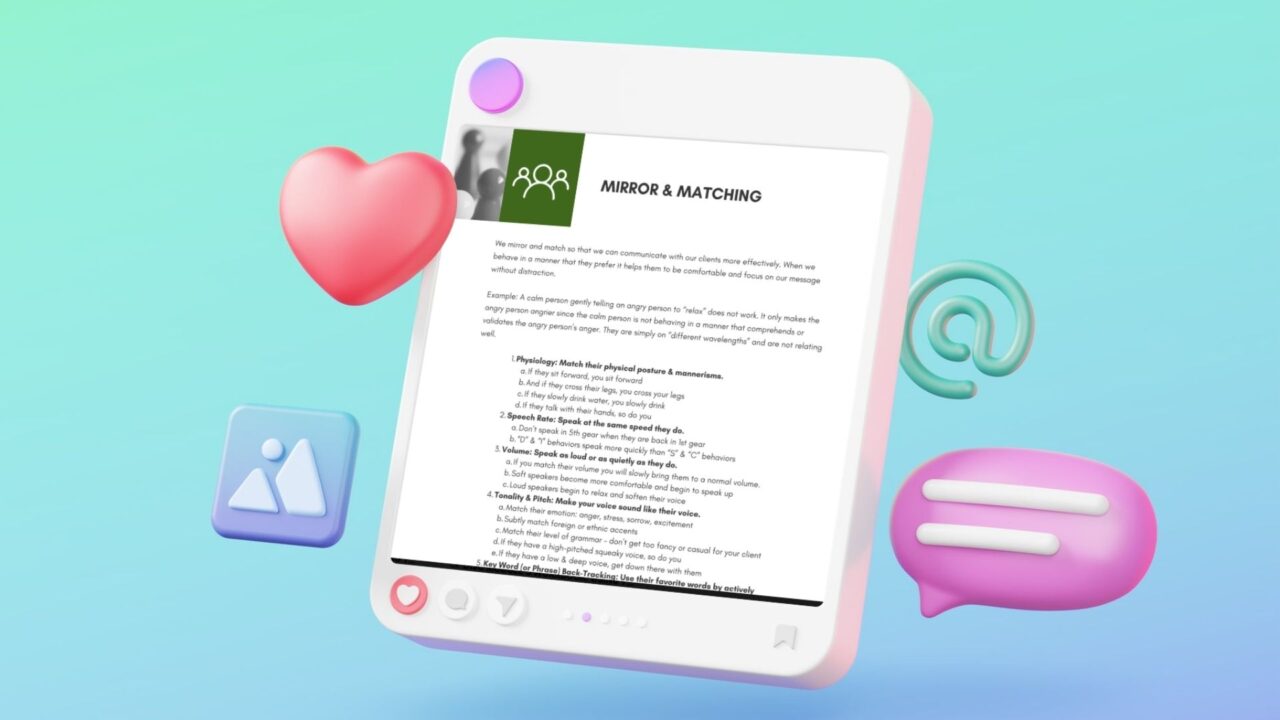
- Workbook: Mirroring & Matching
- Video: How to Mirror and Match
- Mirroring and Matching Cheat Sheet
- Workbook: Using DISC with Clients
- Video: Using the DISC with Clients
- Workbook: Using DISC with Lead Generation Methods
- Video: Using DISC with Lead Generation Methods
- DISC Behavioral Assessment
- DISC Lead Gen Tendencies
- Workbook: DISC Profiles for Different Real Estate Team Roles
- Video: DISC Profiles for Different Real Estate Team Roles
- Workbook: Training Team Members Using DISC
- Video: Training Team Members Using DISC
About this course
- $299
- 26 lessons
- 2.5 hours of video content
Immediate Takeaways
Here is what you can expect to gain from taking this online course.
- CHARTS that demonstrate the differences between the DISC profiles. Learn what makes a D behavior, I behavior, S behavior, and C behavior, and what makes them different from each other.
- GRAPHICS to illustrate key concepts as they relate to learning about DISC behavioral profiles. You will be able to visualize the differences between the profiles, which will help you identify them as you learn through the course.
- CHEAT SHEET on mirroring and matching DISC behaviors to help you learn how to better communicate with all behavioral styles.
- OPTIONS for how you learn best. Each module provides a downloadable PDF chapter as well as a featured video of Brian Icenhower, teaching the topic at hand. At the beginning of the course, you are also provided with a full audiobook to listen to. So however you learn best -- we have an option for you!
DISC: Understanding Behavior in Real Estate
More about this real estate training course
Reviews
"I use ICT systems, the Icenhower Institute, and the coaching program to coach and train my team of over 30 agents. I use the ICT dashboard systems to keep my entire team accountable for their activities and set proper expectations." Jake Rockwell Over 500 Units Sold Annually "I have coached with ICT for over five years. ICT has helped me quadruple my luxury business through marketing strategies so that I receive listings and sales through lead generation and multiple pillars of income."
Dennis Adelpour Luxury Agent - West Los Angeles "When we started coaching with ICT we worked all the time with some degree of success. Now, seven years later, we have grown to have the #1 market share in our area, we more than tripled our income and production, while also improving our work-life balance to enjoy our personal life with family and friends."
Tammi Humphrey #1 Market Share & 100 Million in Annual Sales Volume Instructor
Brian Icenhower.
Discover the crucial relationship between human behavior and every facet of the real estate business.
This course, DISC: Understanding Behavior in Real Estate, gives invaluable insights into the nature of behavior and how to apply it to everything you do in real estate. You’ll learn to identify different behavioral types and modify your communication style to effectively build relationships with all types of clients, as well as vendors, stakeholders, and all the other people you'll meet in the course of doing business.
Not only will the client leads that you generate significantly increase, but your level of customer service and lead conversion rates will dramatically improve as well. You’ll gain insight on which types of business marketing and lead generation methods are the best fit for your behavioral style, and even how behavior impacts hiring and training within real estate teams.
This course will show you how to harness your strengths while overcoming the behaviors that are holding you back from success.

Harness your strengths.
Understand the people you interact with, and use that information to your advantage with this DISC: Understanding Behavior in Real Estate course.
Add to CartTalk to a coach
If you've been considering hiring a coach, now's the time. Book a FREE coaching consultation session with your purchase of this course! Book Your Call

See all courses
-
Quick View
1×1 Solo Agent Weekly Coaching Program
$1,000 / monthThis 1×1 Solo Agent Weekly Real Estate Coaching Program designed to help you increase your production and your commission income with strategies and systems for sustainable business growth.
Watch for “I Got This, I Got This”
When someone keeps saying “I got this” during training, they usually aren’t listening. This is the one time they have your full attention. If they don’t get it down now and you have to step back in later, you’ve got problems.
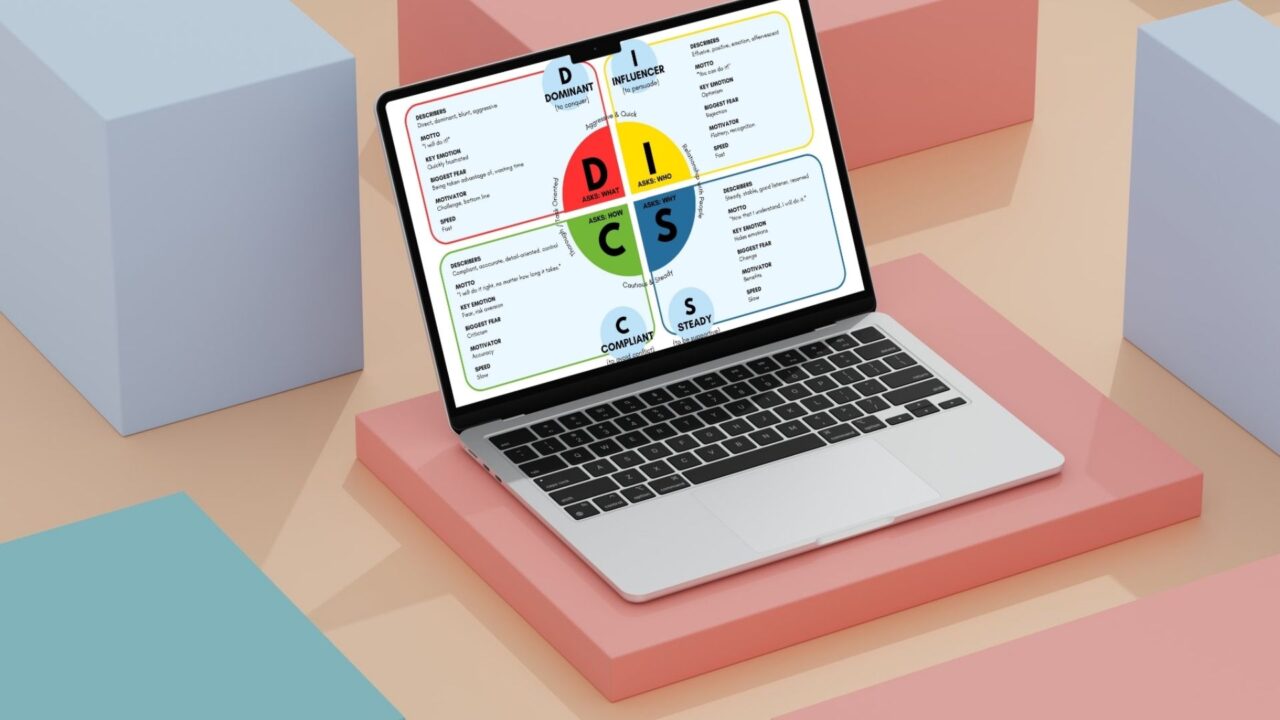
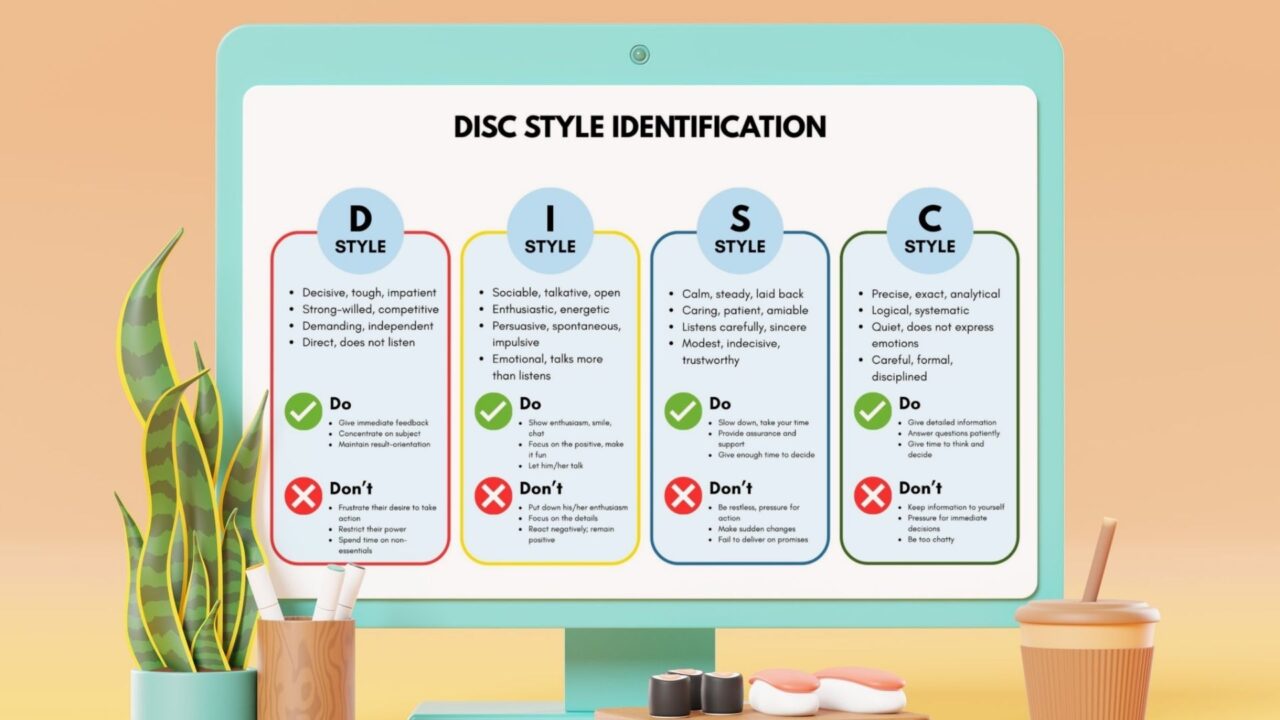
You’ll see this most with certain behavioral profiles. In DISC terms, people with a lot of I or D in their profile want to take it and run. They learn by doing. S and C profiles tend to listen a little better.
That does not make an I or D hire a bad hire. It means they need to be self-aware, put on a filter, and be patient through the We phase before they go. Talk about it openly. If your team uses DISC, this is a great place to apply it.
Better to Train Too Much Than Not Enough
The worst thing that happens when you train too much is that it gets a little boring. The risk the other way is much bigger. If you’re not patient, the coordinator doesn’t really have it, mistakes happen, and then you have trust issues and letting go issues. Those can be catastrophic for a team.
So be patient with I, We, They. Stay with it, and get through it with every task you give away.
Your Transaction Coordinator Training Checklist
- List every task on your listing and closing checklists.
- Rank them from easiest to let go of to hardest. Start easy.
- Record yourself doing each task on a screen share. Save every video.
- Set a We phase for each task: they prepare it, you edit it, until edits stop.
- Show your new hire the I, We, They curve in week one.
- Tell them the micromanagement has an end date.
- Once a task stops needing edits, stop checking it.
If you want to see the full job your coordinator is stepping into, start with our real estate transaction coordinator workflow, and if you are still deciding who to hire first, read whether to hire a transaction coordinator or an administrative assistant.
Get Help Building Your Admin Training
Our ADMIN course walks you through training real estate administrative assistants step by step, and our coaches work with team leaders on this exact handoff every week. Book a free coaching call and we’ll help you map out which tasks to let go of first.
Want to hear me walk through I, We, They? Watch the full video.
Subscribe to The Brian Icenhower Podcast and follow ICT for new training every week.
Video Transcript
Prefer to read along? Here’s the full transcript from this training video.
Brian Icenhower: Talking about training real estate transaction coordinators or administrative assistants on a real estate team or in a brokerage, I have a process that I refer to as the I, We, They process. What I mean by that is, as we’re learning a new task or even an entire job, they’re going to watch me do it, then we’re going to do it together, and then I’m going to let go, and they just do it.
I know that sounds simple, but let me give you an example of how that works. Let’s say one of the toughest tasks for agents to let go of is preparing a comparative market analysis, or a CMA. Most agents hang on to that and never give that to any type of assistant. And when you’re preparing a CMA, someone taught you to do it.
It’s not all that tough. We’re just afraid to train it. And the way we train it is very simple. They watch me do it. So I do it, let’s say, three to five times, and they watch that. They review it. Nowadays we’re recording a video, and they’re actually seeing with a screen share video how I prepare a CMA.
Then hopefully we save that video and use it for training in the future, so that we systematize via video. Then we do it together, which means they prepare the CMA first, and then before we use it, I edit it. I’m going to take a look at it. I’m going to edit it.
I’m going to correct any mistakes. And then they’re going to keep doing it, whether that’s three or five times, until it doesn’t need my edits anymore. Now we’ve begun to let go of that task, and then we move to the They. That means they are going to start doing it on their own, and pretty soon I’m going to rely on them so I don’t need to check it.
So when I’m taking a lot of listing appointments, I just basically tell them the address, and voila, I’ve got a CMA. Throw it in my laptop or my listing packet, and I’m out the door. So it’s a process of I, We, They. I do it, they watch me. We do it: they start it, and we edit it until we get it right. And then they do it, and we let go.
The important thing here is that this solves two problems. First of all, the person that doesn’t want to let go, which is almost always the case with the team leader.
It’s their clients, it’s their business, they do it their way, they want to do it. It’s a process where they get confidence to let go. And then typically with top talent in the administrative assistant position, they’re going to want to take it away too fast. They’re always going to be grabbing and taking it.
“I want to take it off your plate so you can generate more business. I got this, I got this, I got this.” That’s often the case with highly talented hires, and that’s what you want. You don’t want to squash that. But at the same time, we really want to make sure we let go and have the job not come back to us, because that’s the biggest frustration.
We didn’t put enough training in up front, so what ends up happening is we let go and it’s gone. And then it comes back, and then we’re very frustrated, and oftentimes we never let go of it again. So this is an image that I’ve used over time, and you can see this is the I, We, They.
You can see the I in gray, the We is in yellow, and the They is in green. They do it themselves. And you can see on the left side we’ve got the degree of management oversight, and then we have independence and learning. So you can see the leader is going to have to put a lot of time in to sit there and train it.
We used to just sit side by side and show them. Nowadays, now that everybody’s used to video conferencing and Zoom and all the other video conferencing programs, you can really just record it and have them watch it, and now it’s a resource for them to use forever.
So we start systematizing via video as opposed to having systems via paper. It makes a very big difference. But what you can see is there’s going to be a high degree of management oversight during the I phase, because we’re basically doing it ourselves and they’re watching. But then as we move into the We phase, they start to actually become the laboring oar, where they’re going in and actually preparing, in our example, the CMA, and then we’re going to edit it.
And then slowly, as we move into the They phase, we’re going to give them tons of independence. They’re on their own, and we’re going to step away. And the days I have on here, depending on the task, I just use an example of thirty, sixty, and ninety days. But we’re giving away entire jobs sometimes.
We’re giving away tasks. Typically when we’re training an administrative assistant, we’ve got a listing and closing checklist. And when we have those two checklists, we’re actually training each and every task this way, and we’re letting go of each task on the checklist in a way that we feel comfortable.
Some of those tasks are going to take you, you do it once, they’ve got it, and we let go. Some of the tasks, like a CMA, are going to take a lot of confidence to let go of and a lot of training to know how you like your CMAs. So it’s very important that we acknowledge there is a period here where it takes time to slowly let go.
But the most important part to remember: I like to show that curve to assistants, and here’s why. When a new hire gets hired, especially a talented hire, they don’t want to be micromanaged. They don’t want to be micromanaged, and we don’t want to be micromanagers. Those are typically not good managers.
However, we want to be good trainers. And we want to feel comfortable when we let go, so there are two angles pulling at each other here. So the way I’ll show the curve is to explain, “Hey, I’m only going to micromanage you on this for a little while. That’s it.”
I want to be a macro manager, like most of us do. We want to let go, have self-managed people, and get out on offense and do our business. But I’m going to micromanage you, and the faster we can get through this process, the quicker I’m going to let go. So I actually explain the plan so that they actually see that.
Because here’s the problem. If we don’t take advantage of this time when I’m micromanaging you during the I and the We time, and we don’t listen and we don’t learn, and it’s just “I got this, I got this, I got this,” that’s not a listener. So when people start saying that, we’re not listening.
I don’t care if you’ve got it or not. This is the one time you’ve got me. This is the one time you’ve got me, and if you don’t listen and you don’t get this down and I have to come back in, then we’ve got problems. So we’ve got to be patient.
We’ve got to take this time, and you’re going to see that happen with certain behavioral profiles. Typically, when you’re training someone that has a lot of I or D in their profile, they just want to take it. They want to run. They want to learn kinetically. “I’ll get this.” And that’s what will start to happen, whereas the S’s and C’s tend to listen a little bit better.
It doesn’t mean an I or a D profile is necessarily bad. It just means they have to be self-aware of this, and they have to put on a filter and sit and listen and be very patient and then go. Because the worst thing that happens is we train too much.
That’s the worst thing: we train too much and it gets boring. The risk the other way, if we’re not patient, is that they don’t really have it and we have mistakes, and then we have trust issues and letting go issues, and those can be catastrophic. So it’s better to be patient than not be patient with the I, We, They process, and stay through it and get through it with each task we’re giving away when we’re training someone.